The 2-Minute Version
- US bonds lost 3.5% in Q3. Long-term Treasuries lost 9%. The S&P 500 rose 2.4%.
- Three quarters in a row bonds were underwhelming: flat in Q1, flat in Q2, down in Q3.
- Managed futures rose in all three quarters of 2026.
- Outside of Bitcoin's 42% rebound, energy was the top performer in Q3 as oil climbed back toward $100.
- Bonds are brakes. Use them for known obligations, but know that they are often a poor performer and a poor diversifier for an equity portfolio during inflationary periods.
The Dollar Math In a hypothetical comparison, an individual who placed $100,000 into managed futures instead of bonds this year would be about $20,000 ahead through September. One year proves nothing on its own statistically, and past performance doesn't predict future results. However, it should lead to the question: why do so few physicians hold managed futures when they are more than happy to hold bonds?
Here's what happened in Q3…
What happened in Q3
Stocks went up. The S&P 500 gained 2.4%, carried mostly by a handful of large tech names (Microsoft rose 38% and Meta 29% after strong earnings). This came against a backdrop of the Fed hiking its rate, which drove news headlines for a few weeks.
On September 16, the Fed raised its short-term rate for the first time since 2023, to a range of 3.75-4.00%. Over the quarter, the 10-year Treasury yield climbed from 4.44% to 5.29%, its highest close since 2002. As we stress often in these updates, when yields rise, the prices of bonds fall. This was evidenced by the US bond index losing 3.5% over the quarter and long-term Treasuries losing a whopping 9%.
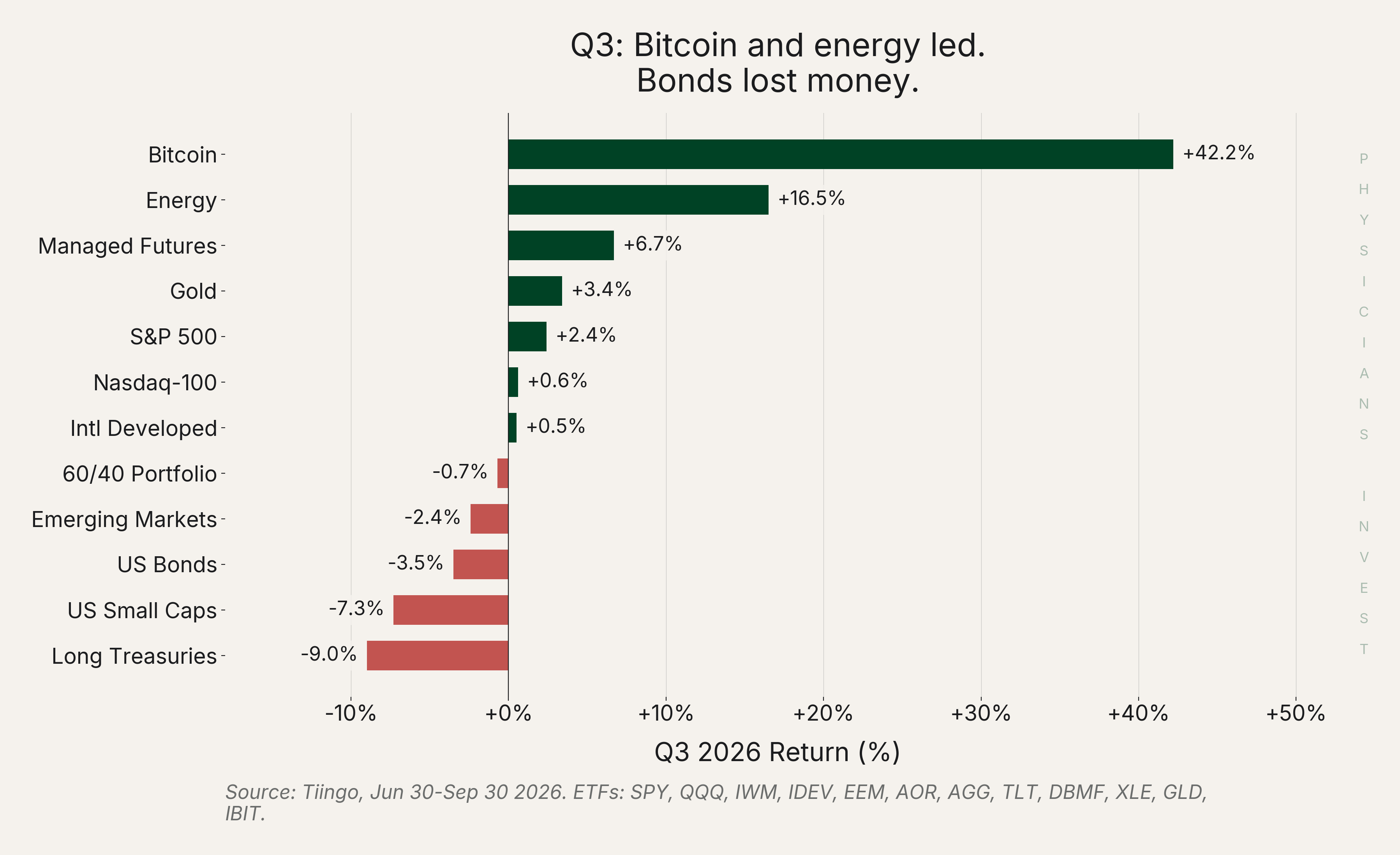 Source: Tiingo, Jun 30-Sep 30 2026
Across the board, rates went up, which affected everything from cash yields to mortgages. While the Fed rate doesn’t affect the daily life of most physicians, things like mortgage rates do. The silver lining is that with a short-term interest rate increase, your savings account and short-term bond holdings now earn a little more. The table below shows practical effects across rate movements in different types of bonds and interest rate instruments.
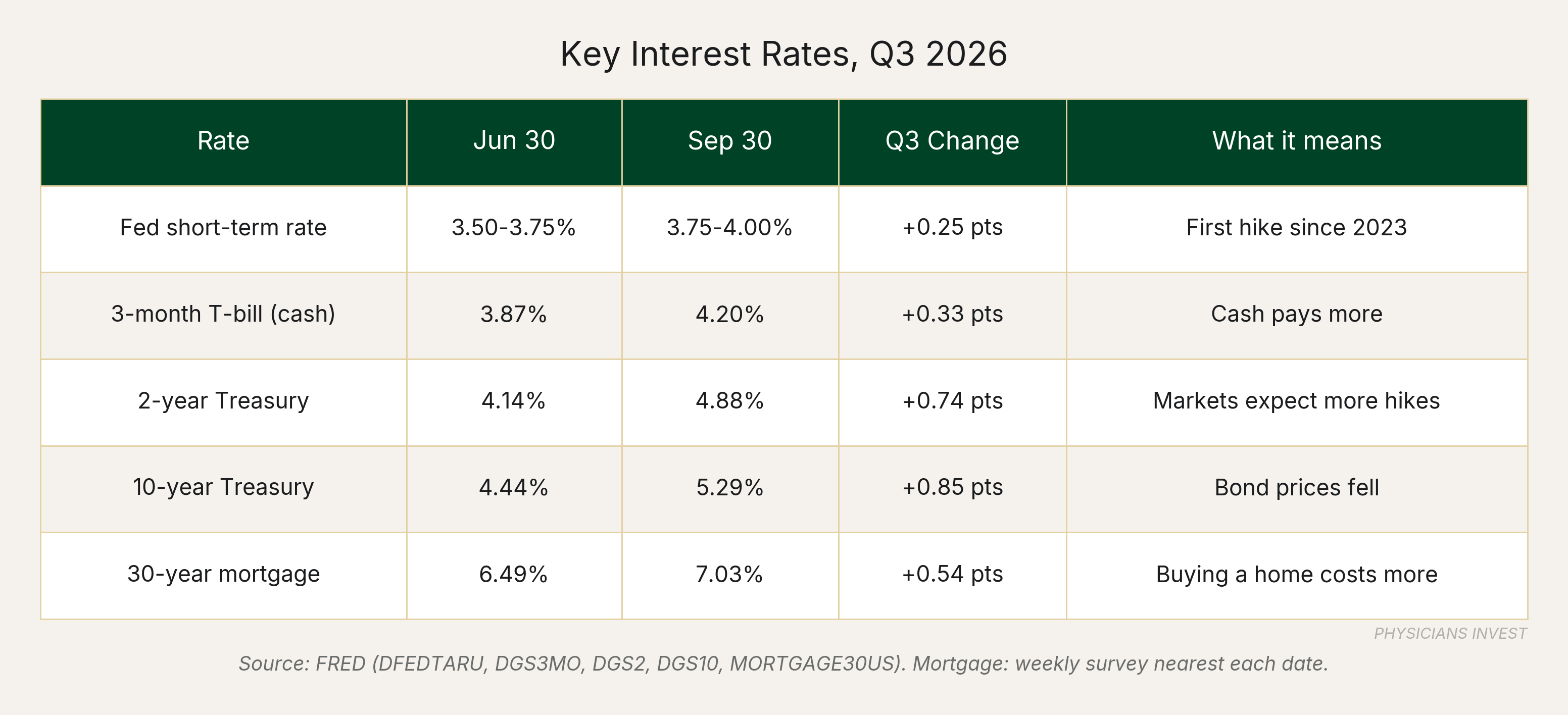 Source: FRED
The overarching story is that bonds have had a bad year and a bad few years. Bonds have a place in portfolios but they are often seen as “safe” which is just not the case. Short-term bonds are safe but their yields are lower. Longer term bonds carry significant risk, especially during inflationary environments.
Bonds across the three quarters of 2026
Let’s look at how asset classes performed in each quarter: stocks, bonds, managed futures. Stocks fell in Q1, ripped higher in Q2, and were up a little in Q3. Bonds were flat, flat, then down. Managed futures (funds that follow price trends up or down across stocks, bonds, commodities, and currencies) rose in all three and are outperforming stocks and bonds on the year.
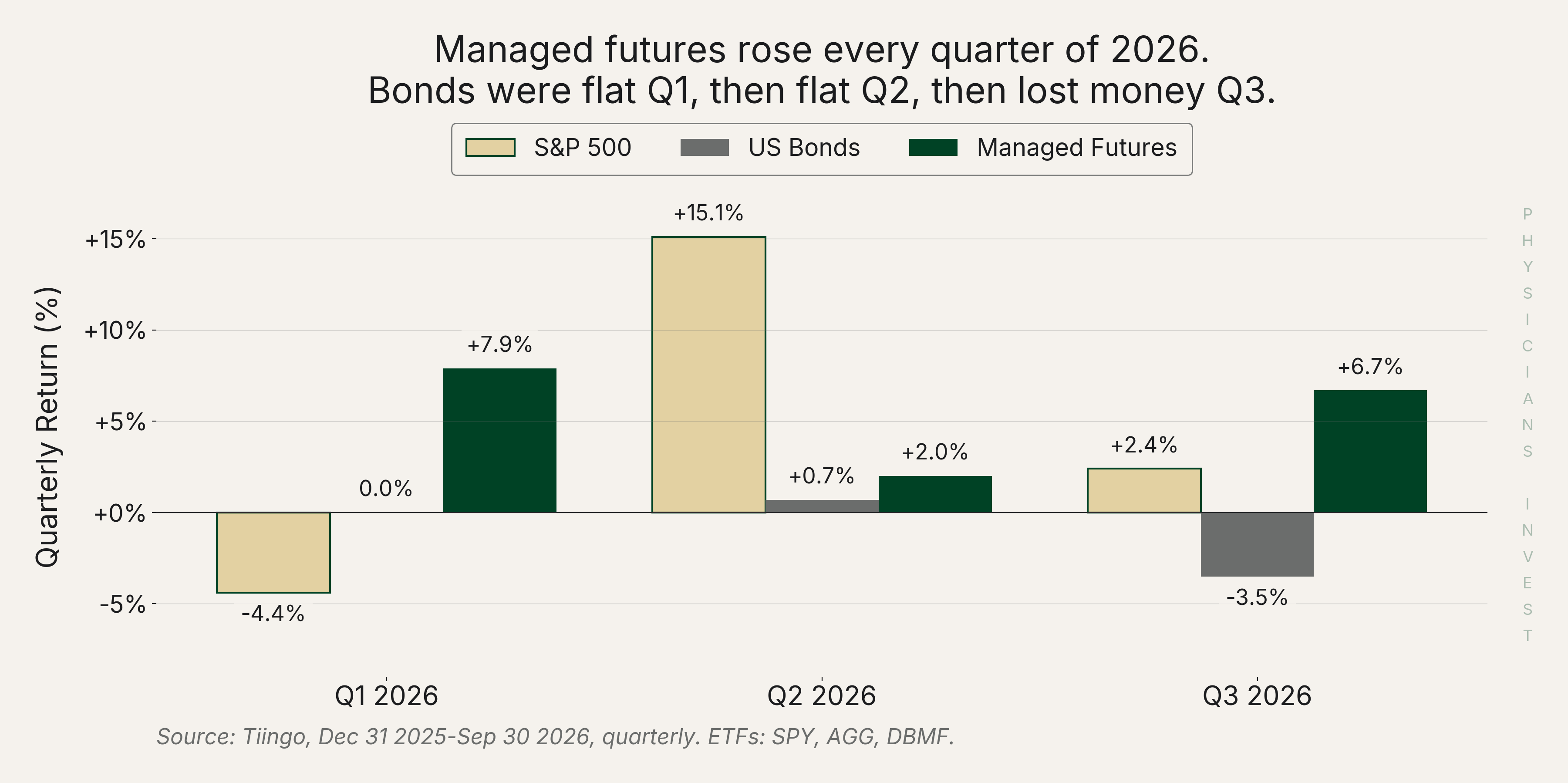 Source: Tiingo. ETFs (exchange-traded funds): SPY, AGG, DBMF
The beauty of managed futures is that they can perform when stocks and bonds both struggle. Managed futures made money in a falling stock market of Q1, a rallying stock market of Q2, and a relatively quiet stock market in Q3. Managed futures are something to put some effort into understanding. We plan to put an article together down the road outlining details of this unique and easy to access asset class.
Why do bonds keep struggling? Answer: Inflation
Inflation is not going away any time soon based on government spending. The Fed says it targets 2% inflation, but since 2022, inflation has stayed above it. The chart below shows inflation, both core and headline, as measured by CPI. Headline inflation sits at 3.4% as of the last reading. To put this more viscerally: at this inflation rate your savings account is losing you money every year after taxes! Core inflation, which excludes food and energy, is 2.4%, which is always a funny way to look at things, since food and energy are the main inputs to everyday American life. The economists have good reasons for stripping these out as they are volatile, but for your personal life you should always reference “headline” CPI and not “Core” to get an idea of your purchasing power erosion.
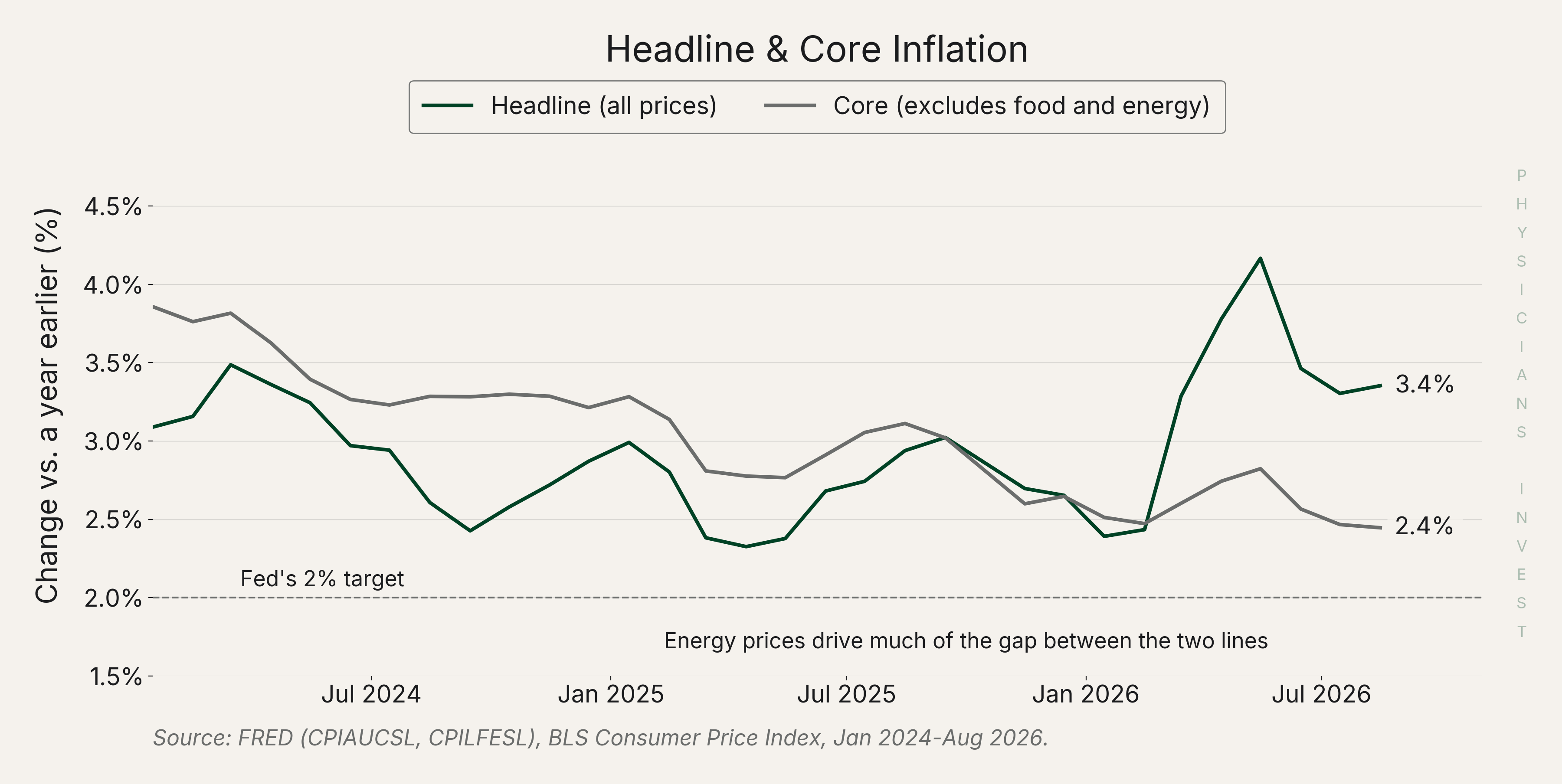 Source: FRED, BLS Consumer Price Index
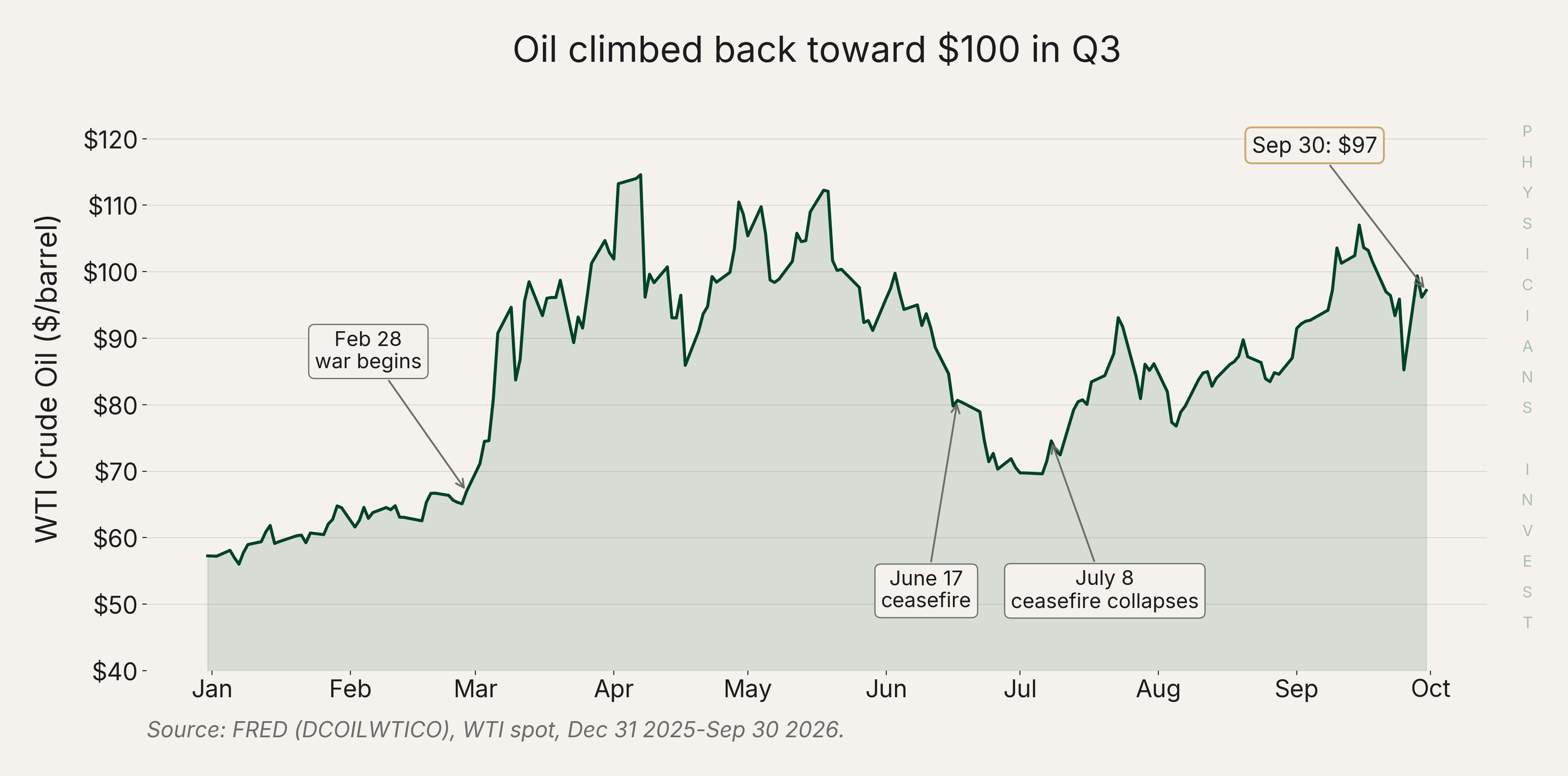
Speaking of energy, let’s look at oil markets. In our last quarterly update, the June ceasefire had just reopened the Strait of Hormuz. It collapsed in early July. Because of this, WTI crude climbed from about $70 to $97 by the end of Q3, briefly topping $100 in mid-September. The government's energy forecasters don't expect Middle East supply to fully recover until 2027, and resource investors like Goehring & Rozencwajg call this the largest oil supply disruption on record. Your takeaway: we wouldn't expect relief at the pump soon, and brace for higher airfares, since the big US airlines no longer hedge their fuel and pass higher costs straight through to ticket prices.
 Source: FRED, WTI spot
Back to bonds now. Let’s think about what a bond is and where they fit in your portfolio, given the abysmal performance bonds have had this year. A bond pays you a fixed amount. In times of inflation, that fixed amount buys less and less of goods, which is bad for you. The government knows this is hard on its citizens and businesses, and therefore the Fed raises rates in an attempt to slow the economy by making borrowed money more expensive. These higher rates push bond prices down, as bond prices and yields move in opposite directions. Decades of research from firms like AQR and Man Group show bonds are a poor hedge when inflation, not a slowing economy, is driving markets. The IMF made the same point this year. We currently have an inflationary economy and a government incentivized to keep it that way. Buyers of bonds, beware.
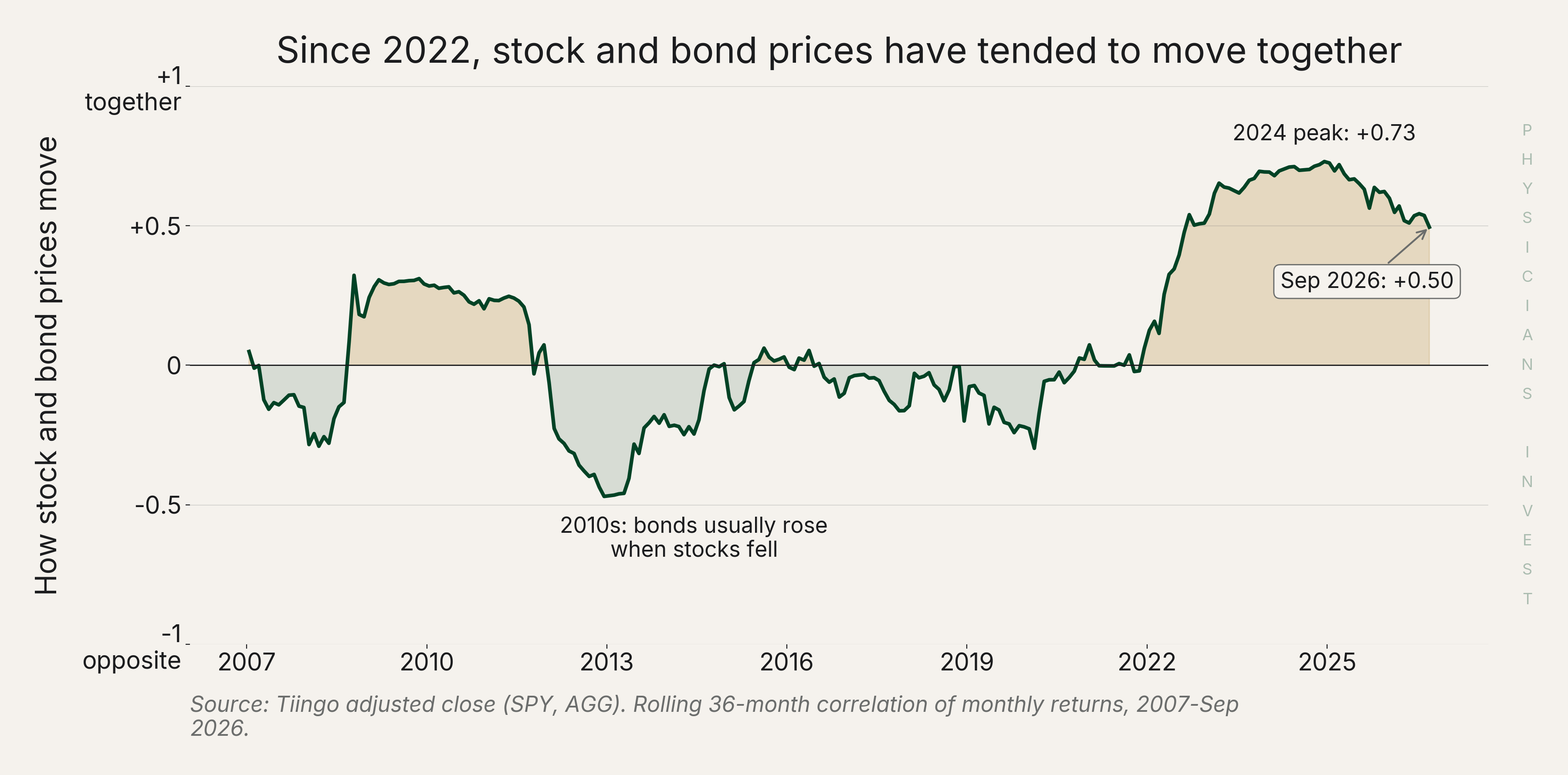
“But bonds are good for my retirement,” my financial advisor said! Let’s look at some history. Bonds are good for portfolios when they perform well when stocks fall. This was the case for the 2010s, which is the history your financial advisor knows and was trained on. Some advisors are still working from that decade's playbook. Since 2022, month to month, stock and bond prices have tended to move in the same direction, which isn’t helpful for a portfolio largely composed of index funds linked to equity such as the S&P 500.
 Source: Tiingo. Rolling 36-month correlation (how closely two assets move together) of SPY and AGG monthly returns
Bonds are brakes, not an engine
Bonds are like brakes on a car. Brakes are not bad, they just aren’t going to get you anywhere. They reduce volatility (how much your portfolio swings), and that's a good thing. But over the long run bonds have barely beaten inflation, and they've lost to it for decades at a time.
So bonds should be treated as insurance against an obligation, not as an asset to grow wealth. Obligations could be things like tuition, a down payment, a planned surgery, or next year's expenses. Use bonds to cover things you will lose sleep over if they were in a more volatile asset. Things that would be nice to have, but aren't a true obligation, probably don't need an allocation to bonds.
A common physician problem related to bonds is target-date funds. Target-date funds add to your bond allocation every year. Vanguard's glide path reaches 50% bonds at the target date. This often means you are more exposed to bonds than you think just when you need to preserve purchasing power the most, near retirement. Again, bonds aren’t as safe as you might think they are for a retirement account because in inflationary periods they erode purchasing power.
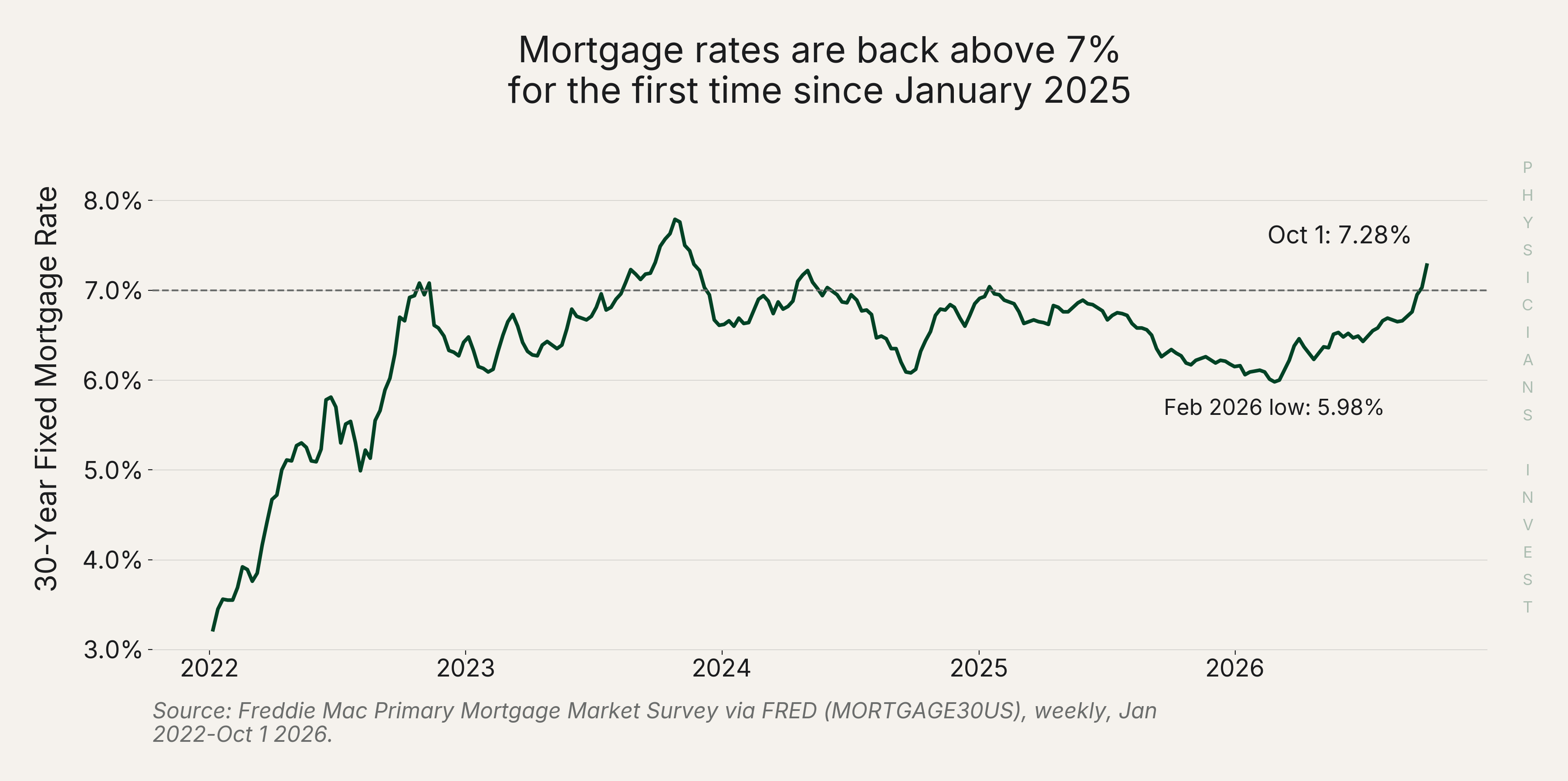
The opposite side of buying bonds is being the borrower. This is most commonly seen with mortgages. You borrow money and pay a fixed rate. This now puts you on the right side of inflation as the amount you pay every year buys less and less in the real world. For this reason long-term fixed rate mortgages can be quite advantageous from an inflation perspective. With that said, the 30-year mortgage rate is back above 7% for the first time since January 2025 and home purchases today only make sense for those in very strong financial positions.
 Source: Freddie Mac via FRED
A note on equity markets for the rest of this year
After a quarter when stocks beat bonds handily, funds with a fixed stock and bond mix (pensions, balanced funds, target-date funds) sell stocks and buy bonds to get back to target. Goldman estimated US pensions alone would sell about $33 billion of stocks around the end of September. Most of that happens in the quarter's last days, some spills into early October, and research finds it usually fades within about two weeks. Stocks might wobble some because of that this month, and it is largely due to market plumbing and not a verdict on the economy.
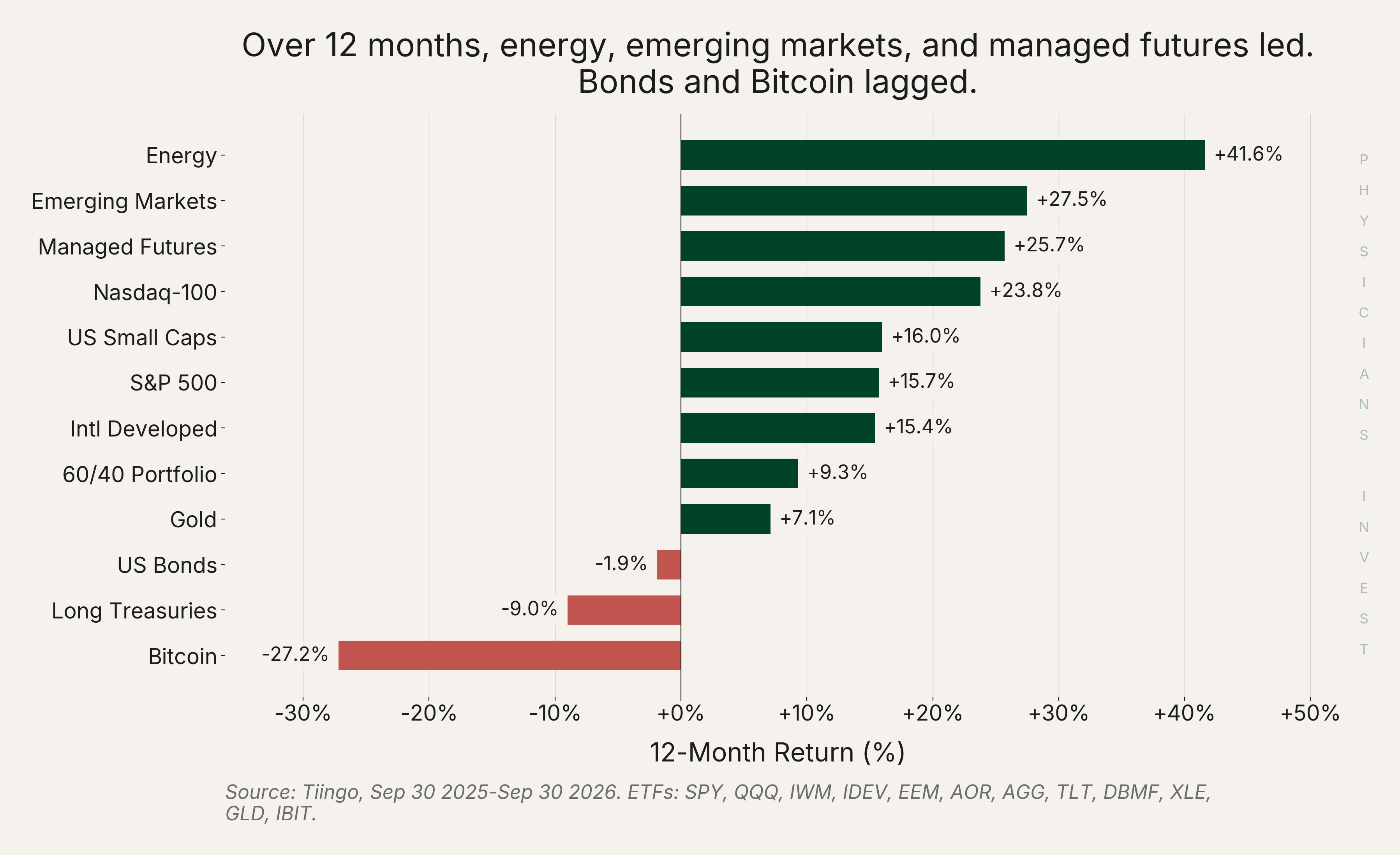
Lastly, let’s look at how various asset classes have performed over the last 12 months. This makes the value of multi-asset portfolios very clear.
 Source: Tiingo, Sep 30 2025-Sep 30 2026
The Move
- Match bonds to obligations. Name the expense that you want covered with a lower volatility asset. A common approach: stay invested until one to two years before the expense, then shift that money to bonds.
- Check your target-date fund's bond share. If your plan allows it, a later-dated target fund is one way to reduce the bond share inside a 403(b).
- Consider managed futures outside your 403(b). Few 403(b) menus offer them. For physicians who want them, a backdoor Roth IRA (W-2 physicians) or a solo 401(k) (1099 income) works. We think they're one of the most effective diversifiers for an equity portfolio most physicians can access. Physicians who add them often start in the 5-10% range and build toward 20% or more over time; the right number depends on your full portfolio and risk tolerance.
- Keep the bonds you hold short-term. Short-term bonds are a better holding than long-term bonds in inflationary environments. Think short-term TIPS (Treasury bonds that adjust for inflation) outside the plan, or the short-term bond or stable value fund inside it.
- Don't read too much into an October stock market wobble. If stocks wobble this month, it's likely more about quarter-end rebalancing by large funds than the economy.
Sources
Data
- Tiingo API -- ETF and equity adjusted close prices (SPY, QQQ, IWM, IDEV, EEM, AOR, AGG, TLT, DBMF, XLE, GLD, IBIT, MSFT, META)
- FRED -- Treasury yields (DGS2, DGS10), Fed target (DFEDTARU), 3-month T-bill (DGS3MO), 30-year mortgage (MORTGAGE30US), CPI (CPIAUCSL, CPILFESL), WTI crude (DCOILWTICO)
- Freddie Mac PMMS -- 30-year mortgage rate, 7.03% close Sept 24 2026, first time above 7% since January 2025
Government
- Federal Reserve FOMC statement, September 16 2026 -- first hike since 2023
- BLS Consumer Price Index, August 2026 -- headline 3.4%, core 2.4%, energy +16.3%
- EIA Short-Term Energy Outlook, September 2026 -- Middle East supply disruptions into 2027
Research
- IMF Blog: Stock-Bond Diversification Offers Less Protection From Market Selloffs -- positive stock-bond correlation regime since 2020
- AQR: A Changing Stock-Bond Correlation -- bonds are a poor hedge when inflation, not growth, drives markets
- Man Group: The Best Strategies for Inflationary Times -- trend-following as the most reliable inflation-shock hedge
- Vanguard: How America Saves 2026 -- how common single-fund target-date holdings are among retirement savers
- NBER: The Unintended Consequences of Rebalancing (w33554) -- quarter-end rebalancing price pressure resolves within about two weeks
Physician / Industry
- Vanguard: Target-date fund glide path -- glide path reaches 50% bonds at the target date
Analysis
- IREI: Could the oil tanks run dry? (Goehring & Rozencwajg, Q1 2026 commentary) -- "the largest oil supply disruption ever recorded"
- Damodaran, NYU Stern: Historical Returns on Stocks, Bonds and Bills, 1928-2025 -- 10-year Treasuries 4.5%/yr vs 3.0% inflation; -56% real, 1941-1981
News
- Fortune: Microsoft biggest one-day gain since 2008 -- Q3 earnings-driven rally context
- JPT: US-Iran conflict flares back up, disrupts Strait of Hormuz once again -- ceasefire declared over July 8
- Reuters (via Global Banking & Finance Review): Bond selloff could mean outsized portfolio changes at quarter's end -- Goldman Sachs estimate of ~$33B in pension stock selling around quarter-end
Related from Physicians Invest