The 2-Minute Version
- Renting a starter home is cheaper than buying one in all 50 largest metros right now, by about $860 a month on average.
- Buying beats renting only after about 6 years of ownership on average, and 16+ years in the big West Coast metros. Roughly 60% of physicians leave their first post-training job within 3 years.
- Rent through job #1. Buy only when the city is permanent, the market favors buyers, and you'd have a way to rent the home out if life changes.
The Dollar Math Renting through a 2-year first job instead of buying on arrival avoids roughly $62,000 in exit costs on a $600K house, even after crediting the equity you'd build. While you rent, the monthly bill runs about $858 less than owning the same starter home.
We’ve all heard this line before: “don’t throw your money away on rent”. We believe that for most attendings considering this decision, the more accurate line should be: “don’t throw money away on home ownership”.
The setup: Rates went above 6% and have stayed there
The 30-year fixed rate mortgage sits at 6.65% today. Unfortunately even though the Fed has cut rates, mortgage rates have stayed high. When the Fed drops rates that affects short term lending, but mortgages are pegged to longer term rates which are more subject to market forces. And the market forces have not been friendly. Mortgages price off what money costs long term, which is why they track the 10-year Treasury plus a risk spread rather than the Fed rate. To put some numbers to this, the Fed has cut 1.7% since late 2024. Mortgage rates haven’t gone down at all. Unfortunately this spells “expensive borrowing” for homeowners for the foreseeable future and thus drastically affects the rent vs. own calculus. The chart below illustrates the relationship of mortgage rates to both the Fed rate and the 10-year Treasury rate.
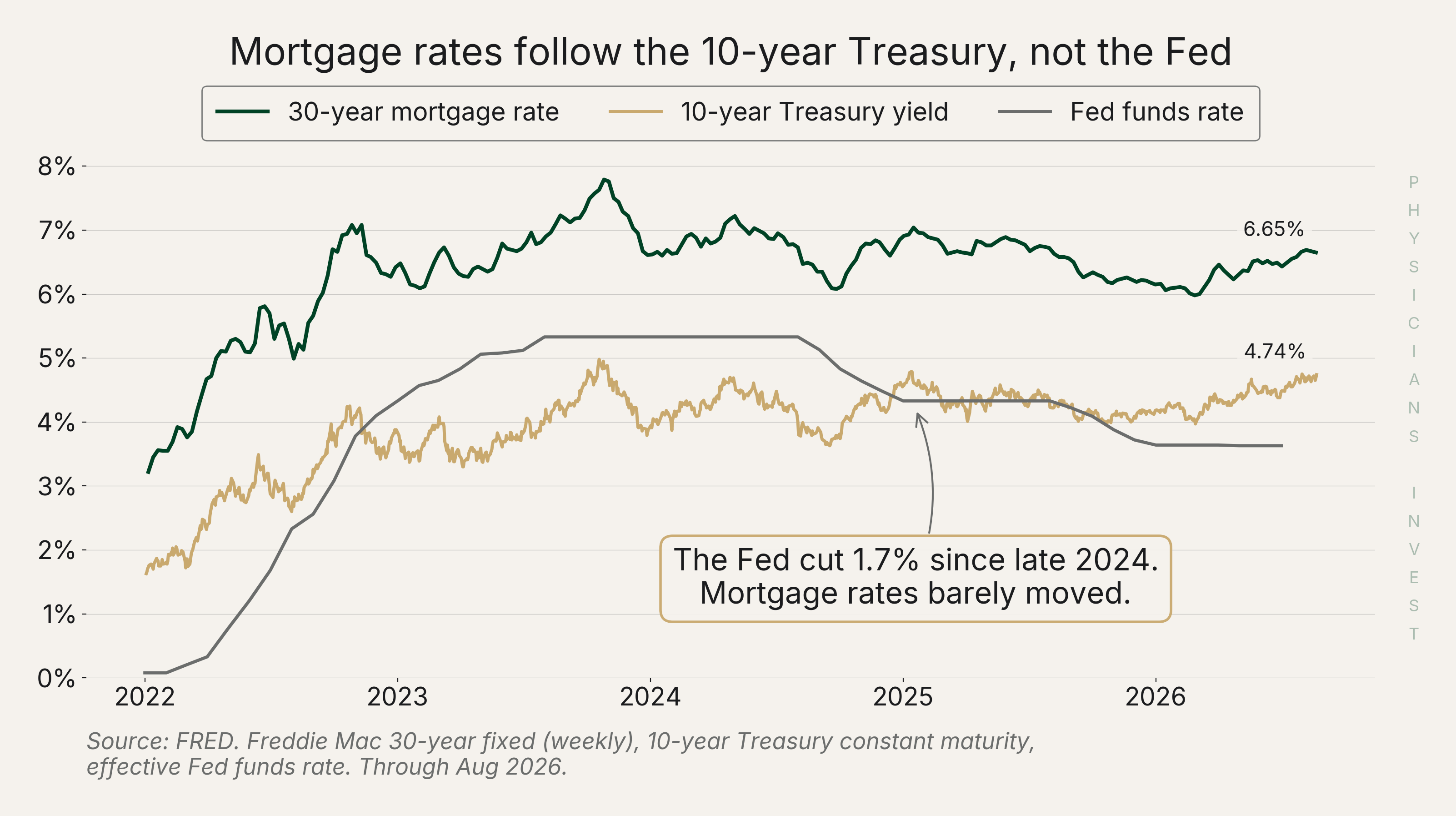 Source: FRED, Freddie Mac
While rates above 6% feel expensive, if we zoom out, today's rate stops looking like an excessive grievance. The 55-year average is 7.7%. The 3% mortgage was an anomaly, and the major forecasters see mid-6s for a while: Fannie Mae's July forecast has the 30-year near 6.4% through year-end, and the Mortgage Bankers Association sees roughly 6.5% into 2028.
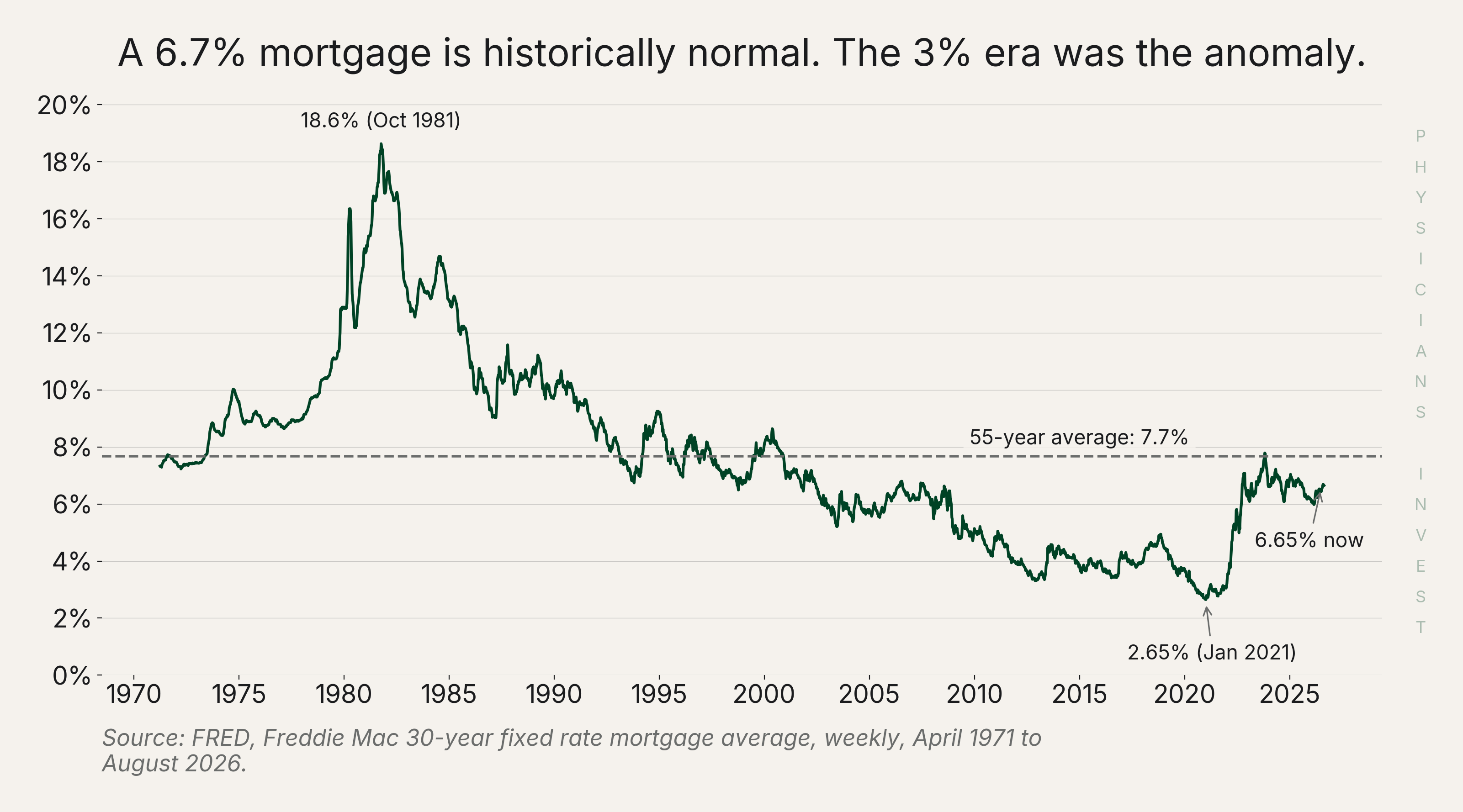 Source: FRED, Freddie Mac
New attendings across America are faced with a decision. Buy or rent? Using today’s rates and assuming an average mortgage and house cost the critical thing to know is what is the breakeven point. How long you must own before buying beats renting, and how does that compare to how long new attendings keep their first job?
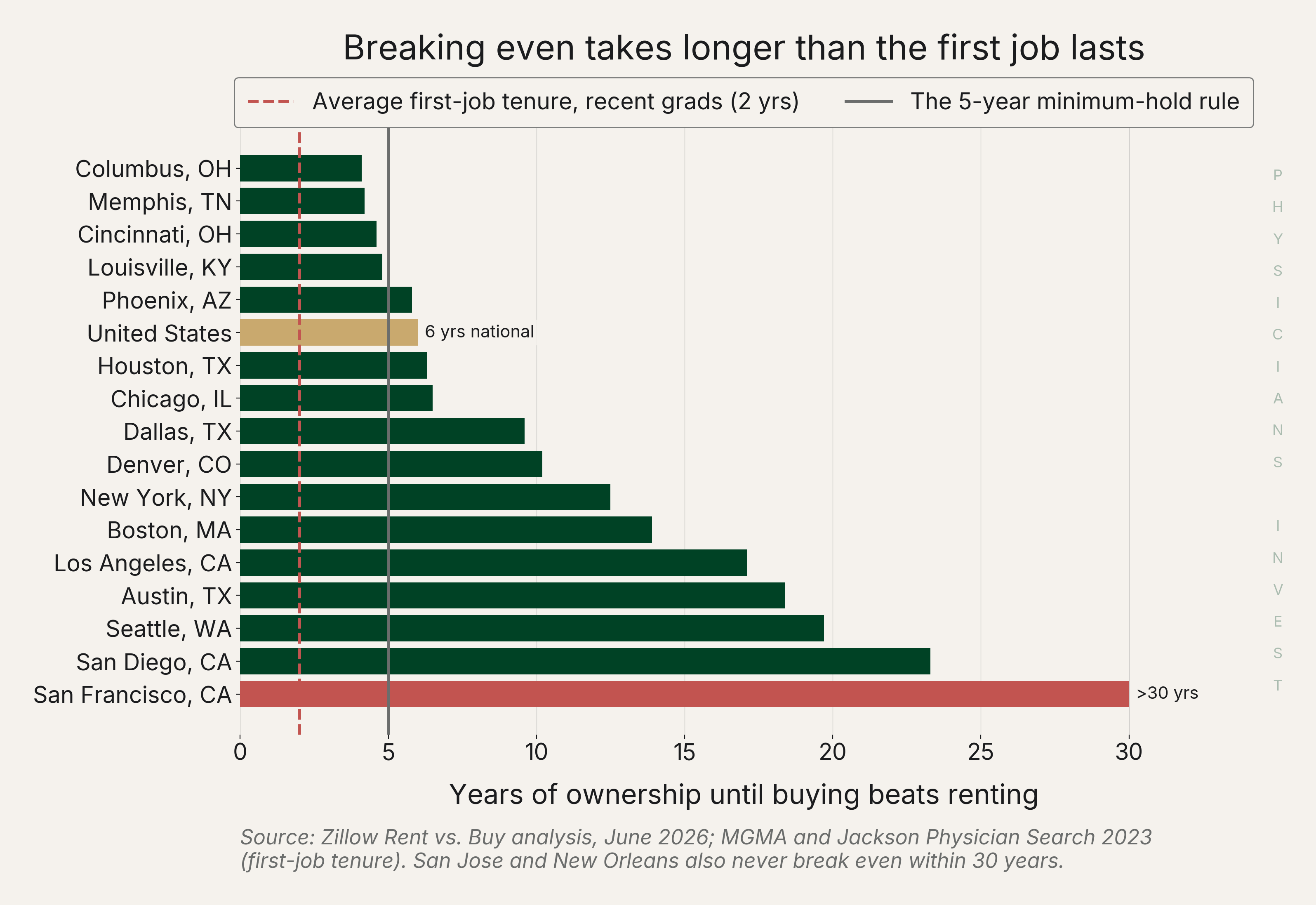 Source: Zillow, June 2026; MGMA/Jackson Physician Search
The red line is the average first-job tenure for recent grads. Notice that in most large metros, the bars don't come close. This doesn’t make buying wrong as there are pros to home ownership that we will cover later, but it should give every physician pause to deeply assess the situation.
The case for buying
Ownership buys you two things renting can't: a locked payment and control. A fixed principal-and-interest payment doesn't care what market rents do for the next 30 years. You can renovate, have as many pets as you want, put down roots, and never have to worry about a lease renewal. Further, in quick to break-even metros (Columbus, Cincinnati, Louisville, Memphis), buying pays off in 4 to 5 years which makes the math work out better than the coastal cities.
Don’t physician loans help with this? The physician loan is a genuinely good product: zero to 10% down, no private mortgage insurance (the monthly penalty other low-down buyers pay), and underwriting on your income rather than your savings. With that said, physician loans often leave doctors over-leveraged and therefore more subject to losses in weak real estate markets. We recommend to incorporate the terms into your calculations but try to avoid extremely small down payments.
Aren’t homes a good investment? While real estate does tend to appreciate over time, long term studies show your dollars are better suited for growth when placed into equities. Real estate has a nice feature where it forces you to hold and not sell quickly but if you have discipline, the market has historically been a much better vehicle for long-term growth. The data backs this up: after inflation, US home prices have grown about 0.5 to 1% a year since 1890, versus about 7% a year for the S&P 500. A 30-year academic study of the buy-vs-rent decision found renters who invested the difference finished ahead of owners in the large majority of periods.
What about using the home as a rental? If your purpose of owning the home is to buy and rent to roommates or to eventually turn into a long or short-term rental then we believe a home purchase could be more justified. But if the home is just a residence for your family, all of the above math applies.
What if I just really want to own a home? Great. We totally get that there are emotional reasons to purchase homes and that is totally an ok thing to do. For some, home ownership is a life goal they have always wanted to achieve. Maybe nobody in your family has ever owned one and you would be the first. Total respect for that position. Buying for emotional fulfillment deserves the same respect as a nice watch: is it the absolute best financial decision? Probably not. Is it a bad one? No, not if it's a goal you have had and will add value to your life.
The case against buying
The case against home ownership is two things: arithmetic and a profession that can be hard to predict. The 5-year hold rule is common in finance circles but we believe that in today’s market it should be closer to 7. Most new attendings just can't satisfy it: their first jobs last about 2 years, break-even takes 6 years on average and you never break even within 30 years in the most expensive cities. A first job is a working diagnosis. You don't make critical long-term decisions on a working diagnosis.
"Renting is throwing money away" has it exactly backwards on a short hold because you will come out far far behind if you buy and hold for just a few years, even in a good market. Selling a $600K house in year two costs about $62,000 after crediting the principal you paid down and two years of appreciation. The waterfall plot shows this math.
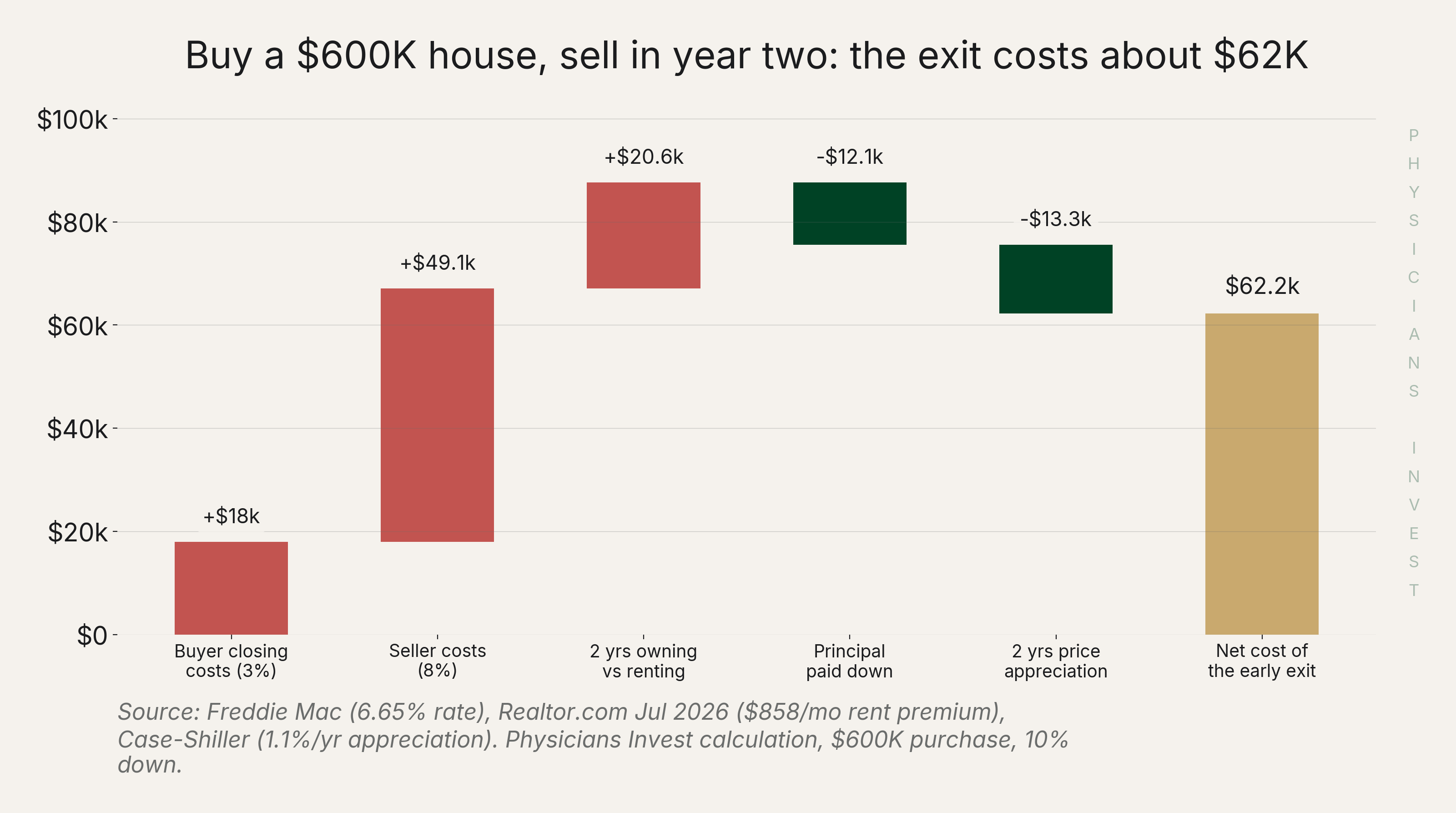 Source: Physicians Invest calculation
To hit this point home, let’s look at rent cost. Renting a starter home is cheaper than buying one in all 50 largest US metros, by $858 a month on average.
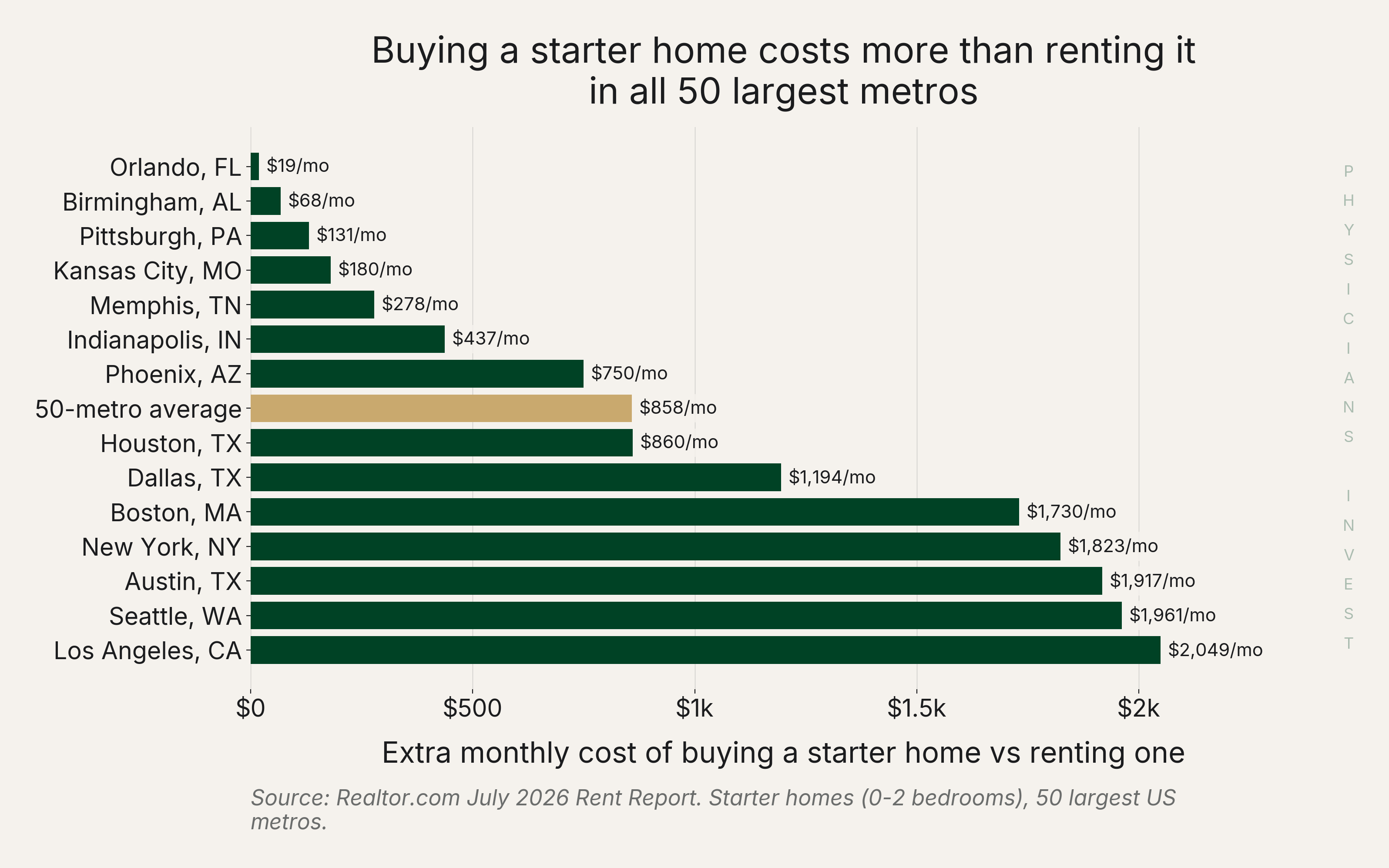 Source: Realtor.com, July 2026
And the non-equity ownership costs keep climbing: property tax averages 0.90% of home value a year (Texas runs about 1.4%, New Jersey and Illinois 1.88%), insurance is up 46% since 2021, and maintenance runs 1 to 2% a year. And even worse, home ownership is a huge mental load.
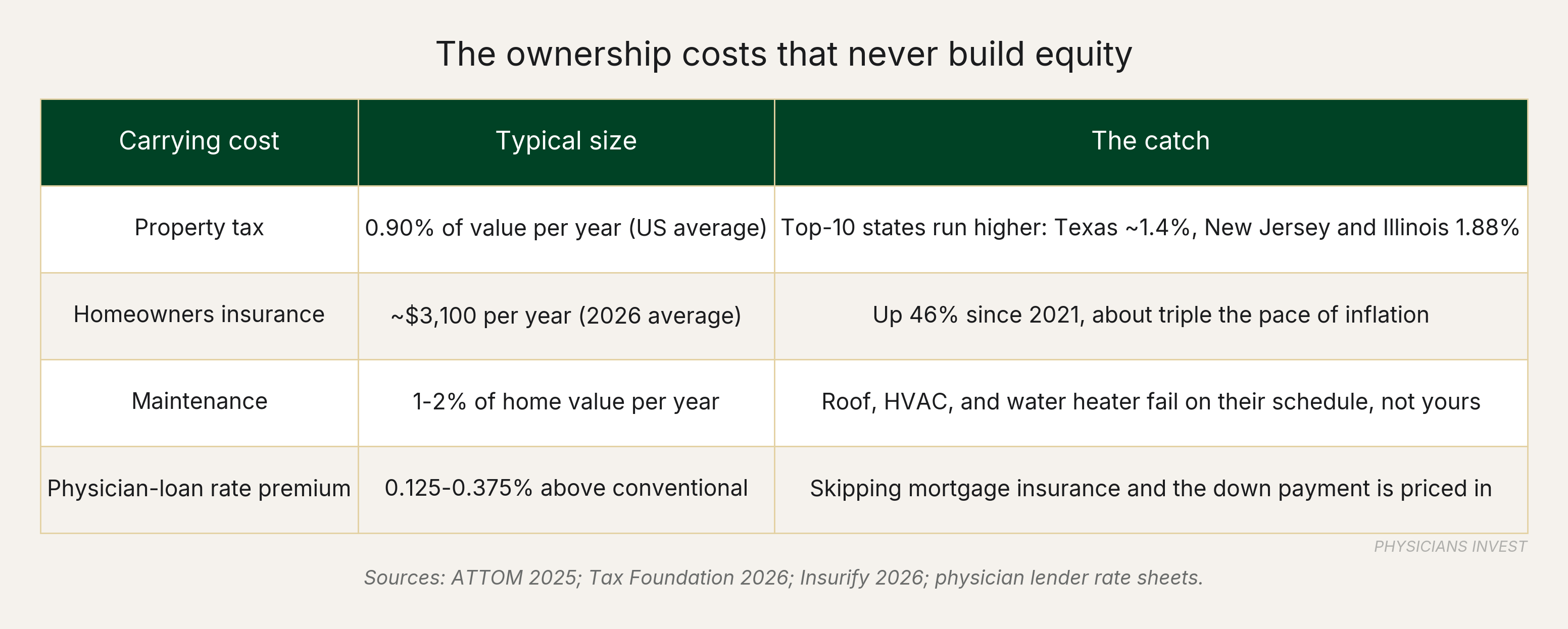 Source: ATTOM, Tax Foundation, Insurify
Here’s a pros and cons side by side that summarizes everything so far:
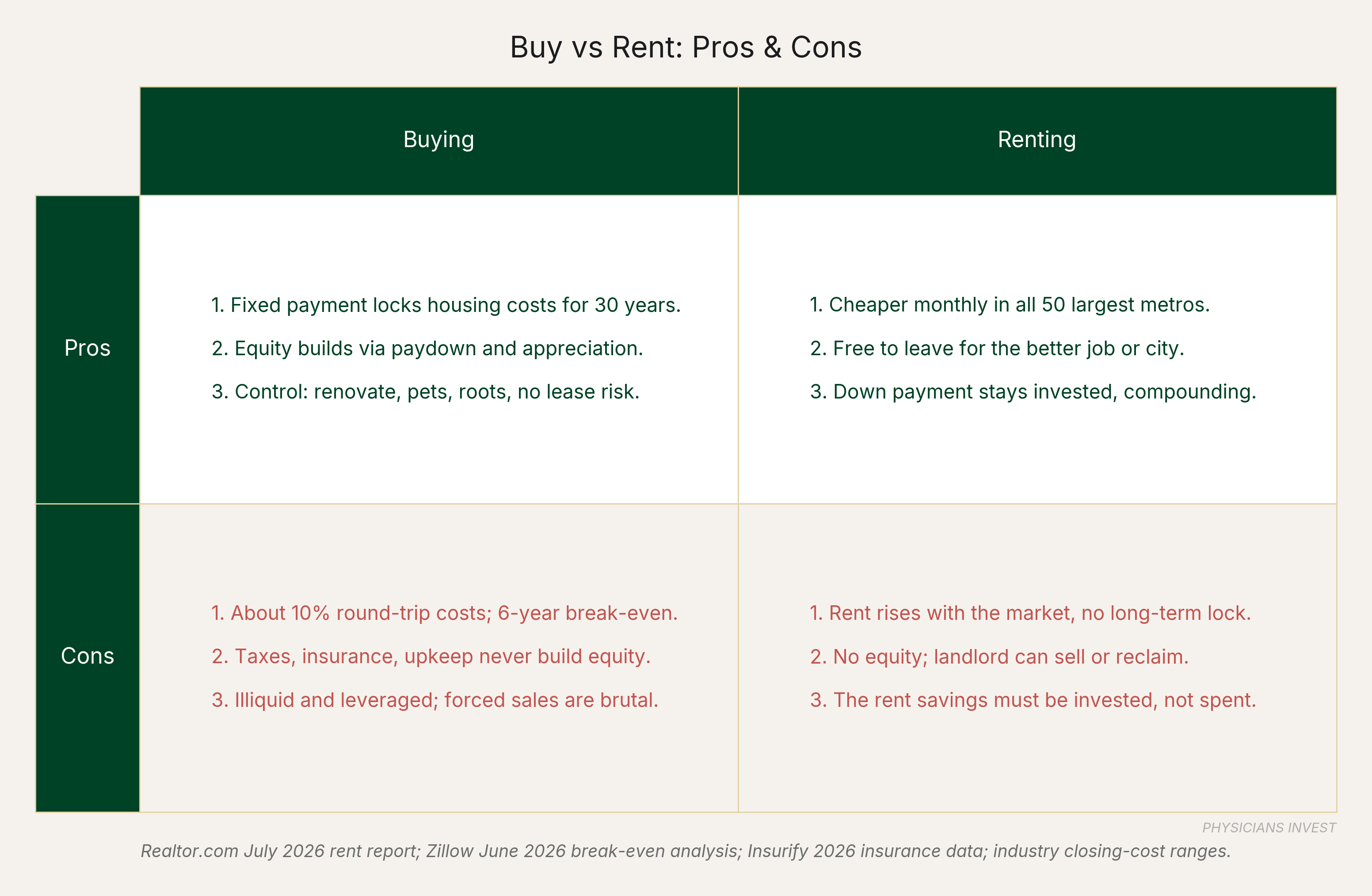 Source: Physicians Invest
How to decide
Every situation is different, but here's the framework we'd apply:
Rent if you're starting your first attending job, there's any real chance you change jobs or cities within 5 years, or you're in a metro where break-even runs a decade plus. Renting, net-net, is the more affordable option, and you retain maximum flexibility to opportunistically follow your best career opportunities or relationships.
Buy only if the conditions line up:
- The mortgage rate is decent and it's not a total seller’s market
- You intend to be in that city very long-term, if not forever
- You have a reason to need control of the house (space, family, renovation, stability, long-term goal)
- You have a line of sight to renting it out now to roommates, or as a short or long-term rental if life moves you
Before any offer, consider this pre-op checklist:
- Talk to local realtors who know where both rent and home prices are clearing locally and aren’t pushy on selling
- Audit your job fairly (would you bet 7 years on it?)
- Check that your rent or mortgage annual payment is under 25% of gross income
- Check that your mortgage total amount is under 2x income
- Calculate your break-even years against your realistic tenure and run sensitivities for 10%, 20%, or 30% down. Don’t forget to factor in what that money could make in the market if not put towards the down payment. (FYI, many online calculators exist for this exact thing)
Sources
Data
- FRED: 30-Year Fixed Rate Mortgage Average (MORTGAGE30US) -- current mortgage rate and 55-year average
- FRED: Federal Funds Effective Rate (FEDFUNDS) -- Fed rate cuts since late 2024
- Freddie Mac Primary Mortgage Market Survey -- weekly 30-year mortgage rate data
- Zillow: Rent or buy? How long it takes for buying to pay off in each metro -- national and metro break-even horizons, down-payment finding
- Realtor.com July 2026 Rent Report -- $858/mo rent-vs-buy premium, all 50 metros
- ATTOM 2025 Property Tax Analysis -- national average effective property tax rate
- Tax Foundation: Property Taxes by State and County -- state-level property tax rates
- Insurify via PR Newswire: Home Insurance Price Projections 2026 -- insurance up 46% since 2021
- Philadelphia Fed Working Paper 24-12: The Price of Housing in the United States, 1890-2006 -- long-run real home appreciation
- OfficialData.org: S&P 500 Returns Since 1957 -- long-run equity real returns
Analysis
- Fannie Mae July 2026 Housing Forecast (TheStreet) -- Fannie Mae's ~6.4% year-end 2026 rate forecast
- Fannie Mae and MBA 2026 Rate Forecasts (ResiClub) -- MBA's ~6.5% forecast into 2028
- Jackson Physician Search: The Surprising Reason Early-Career Physicians Leave Their First Jobs -- ~2-year average first-job tenure (MGMA/Jackson Physician Search, 2023)
- AMA: How to Ask About Retention in Your First Physician Job -- 60% of physicians leave first job within 3 years
- White Coat Investor: How to Buy a House the Right Way -- 5-year minimum hold rule
- Beracha & Johnson, "Lessons from Over 30 Years of Buy versus Rent Decisions," Real Estate Economics (2012) -- renters who reinvest the difference outperform owners in most periods
Industry
- White Coat Investor: The Doctor Mortgage Loan -- physician loan product terms (0-10% down, no PMI, income-based underwriting)
Related from Physicians Invest