The 2-Minute Version
- A whole life policy often takes more than a decade to break even.
- The dividend rate on the carrier's press release is not what your cash value earns.
- The tax code is lopsided against you: a gain on surrender is taxed like wages, and a loss is not deductible at all. A 1035 exchange is often necessary.
- Reduced paid-up (RPU) allows you to stop paying premiums, but it is permanent and can trip the MEC test. Execute with caution.
- Two numbers to know when deciding: how many years in are you, and is the cash value above or below what you paid.
The Dollar Math A 1035 Exchange on an underwater eight-year policy instead of surrendering it recovers about $5,900 of tax, and keeping a 20-year policy instead of cashing it out avoids a federal tax bill of about $36,000 on the gain.
Whole life insurance has a whole lot of hair on it. Let’s state some facts. Insurance is not an investment. Its use is as protection against catastrophe. Whole life is sold to physicians as an investment, usually in residency, and usually by someone who doesn’t know any better themselves. By White Coat Investor's estimate, three in four physicians who bought a whole life policy regret it.
This article is for those physicians who already own whole life and are trying to figure out whether to keep or surrender. This is very common within physician circles and the answer is not often clear-cut. It’s important to understand how the math plays out and what the options are in order to not be stricken with analysis paralysis. We hope this guide helps.
The Setup
What Whole Life Insurance is
Whole life insurance is two products in one contract. The first is a death benefit that pays your beneficiaries when you die. The second is a savings account inside the policy, which the carrier calls cash value. This savings account is what is often sold as the “investment”.
As the policy holder, you pay the same premium every year for life, and the carrier splits those payments across three buckets:
- The cost of the death benefit for that year.
- The carrier's expenses and any commission due to the agent.
- The remainder, which goes into the cash value account.
The cash value grows at a small guaranteed rate, plus a dividend that the carrier declares each year and does not guarantee. In the early years the third bucket (your cash value) is nearly empty, because commissions and setup costs eat the premium. On a published illustration for a 36-year-old paying $12,000 a year, the cash value at the end of year one is $0. All $12,000 went to buckets one and two.
It helps to see whole life next to the other three kinds of life insurance: term, universal, and variable.
Term life removes the savings account entirely. You pay a small premium for a fixed period (often 10, 20, or 30 years), and if you die during that period your beneficiaries get the death benefit. There is no cash value and nothing to surrender. This is the life insurance most physicians should consider, especially if you have children.
Universal life keeps the savings account but lets you raise or lower the premium rather than having it stay fixed. The catch is that the cost of insurance inside the policy goes up every year as you age, and if the cash value can't cover it, the policy drains itself. Indexed universal life is the same structure with the cash value credited off a stock index, subject to caps the carrier can change. Similar to whole life insurance, this product is not ideal for most physicians.
Variable life puts the cash value into mutual-fund-style sub-accounts you pick, so it carries market risk on top of the insurance charges and the fund fees. Similar to whole life insurance, this product is not ideal for most physicians.
Whole life is the most common sold by large firms and is defined by having a fixed premium, a guaranteed cash value, and a dividend. That combination is what makes it easy to sell as an "investment."
The chart below is a breakeven chart for a hypothetical whole life insurance policy.
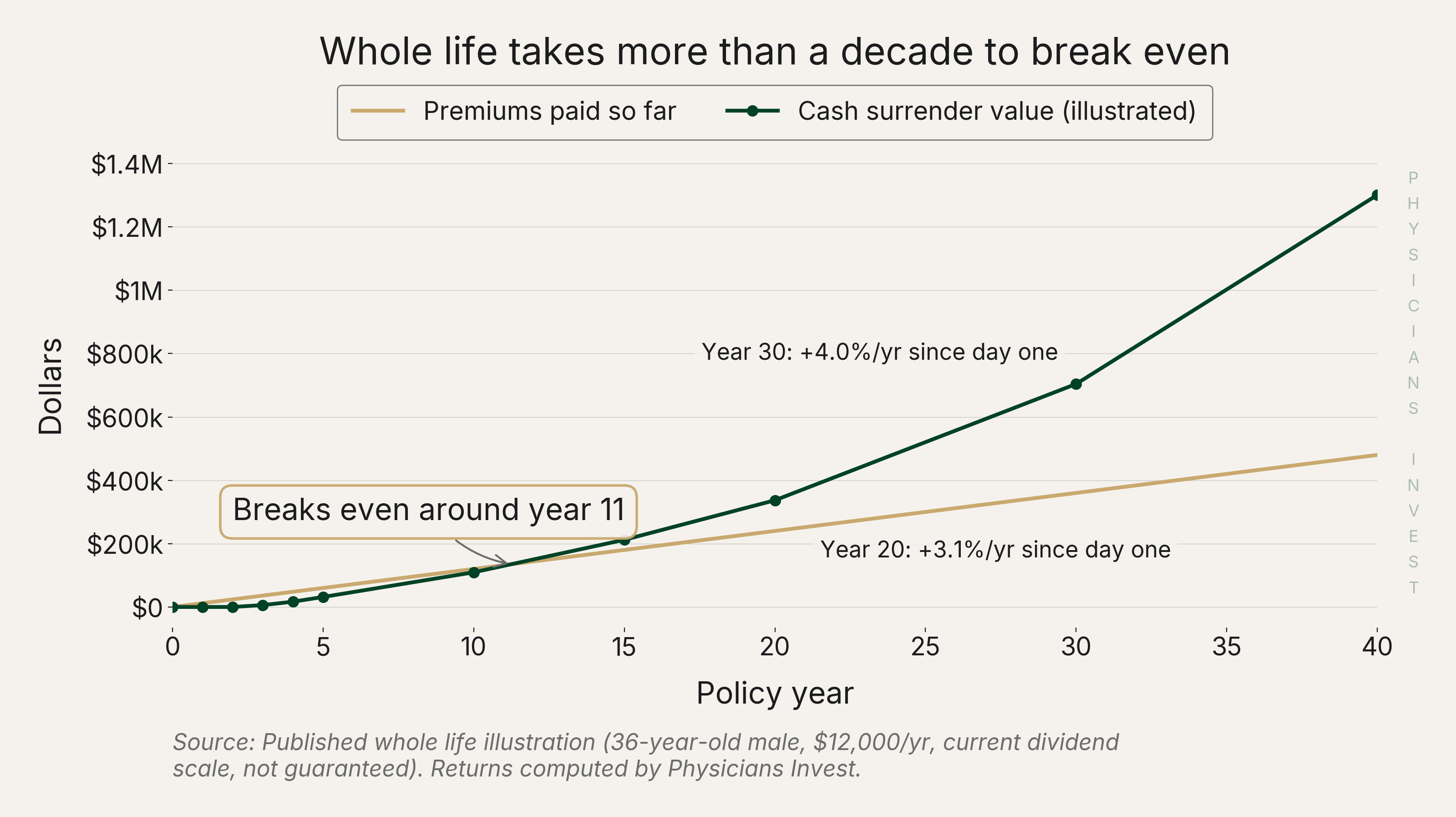 Source: Published whole life illustration (36-year-old male, $12,000/yr, current dividend scale, not guaranteed). Returns computed by Physicians Invest.
Notice that cash value doesn't catch up to premiums paid until around year 11. Even after breakeven, the return since day one is still only 3.1% a year at year 20 (projected, not guaranteed). This shows how poor of an “investment” whole life insurance is.
The dividend rate is not your return
Another pet peeve we have with whole life insurance is that the stated dividend rate is misleading and returns are always lower. Here are the large firm dividend interest rates for 2026: MassMutual to 6.60%, New York Life to 6.40%, Northwestern Mutual to 5.75%. Physicians often read those as their return. They aren't. The dividend rate works like this: a mutual insurer invests premiums in a large, bond-heavy portfolio. Each year its board decides how much of that portfolio's earnings to share with policyholders and expresses it as a rate, say 6.60%. That rate is applied to the policy's reserve (roughly your cash value), and only after the carrier has deducted that year's cost of insurance and expenses. Two things to know. First, the rate has nothing to do with the premiums you paid in. A $12,000 premium does not earn 6.60%; the cash value left after charges does. Second, the charges come out first, so the growth you see in cash value is the dividend minus mortality and expense costs. On the illustration, ongoing cash value growth lands about 1 to 1.5 percentage points below the dividend rate, and the return counted from day one lands 1.7 to 3.5 points below. This reduction in rate is often veiled in the marketing materials.
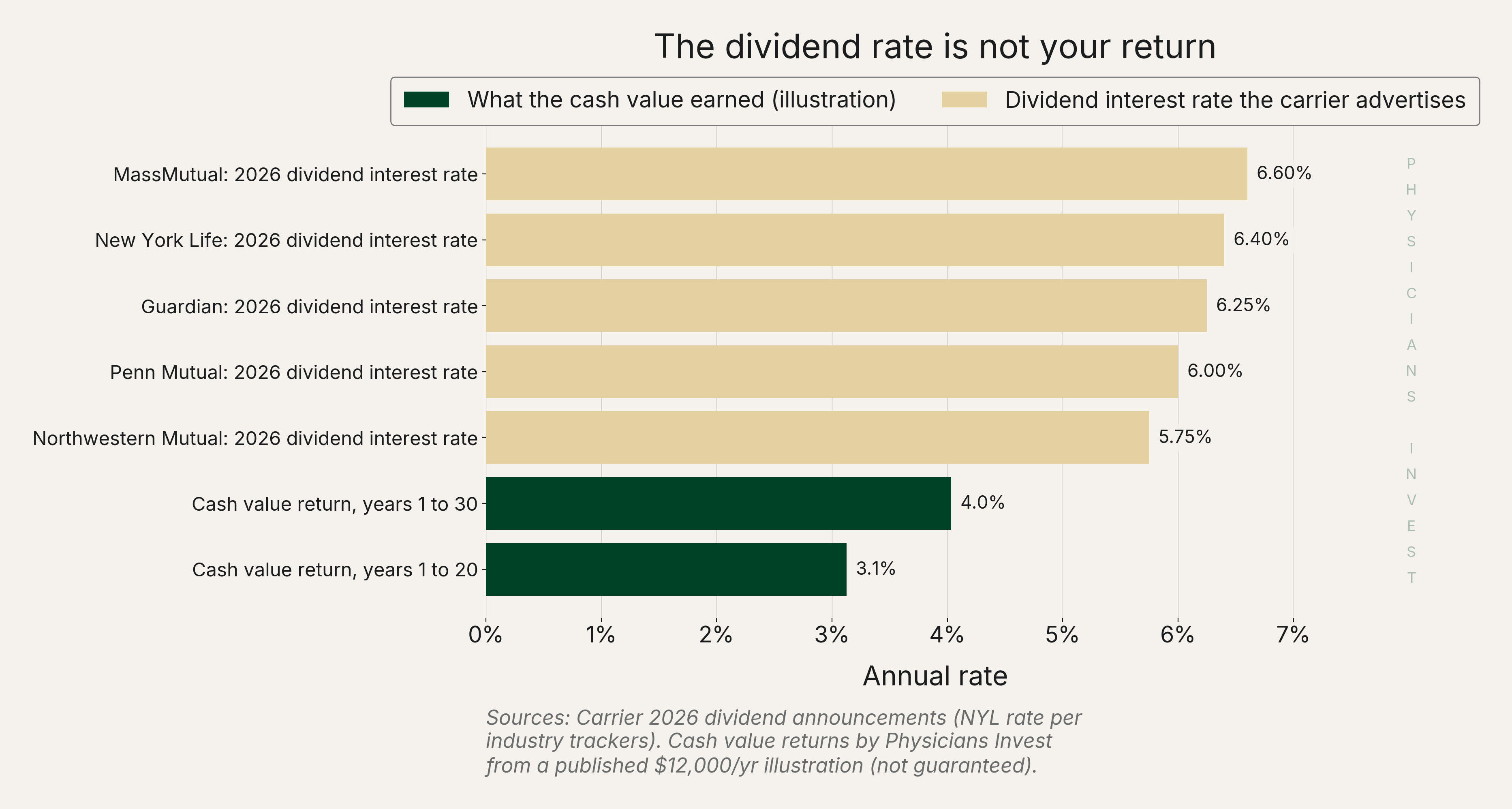 Source: Each carrier's 2026 dividend announcement. Cash value returns by Physicians Invest from a published $12,000/yr illustration (not guaranteed).
The tax rules
Your cost basis (what the IRS says you paid) is premiums paid, minus dividends you took in cash, minus unrepaid loans (IRS Publication 525). Once you know that, figure out if cash value is above or below basis:
- Cash value above basis: the gain is ordinary income, taxed like your wage income. The IRS's own example in Rev. Rul. 2009-13: $64,000 of premiums, $78,000 surrender value, $14,000 taxed at your marginal rate.
- Cash value below basis: a loss exists BUT is not deductible (IRC 165(c)). You eat it because the IRS does not allow a write-off opportunity.
That negative asymmetry is brutal for a physician in the 35% or 37% bracket. Fortunately there is a messy workaround: the 1035 exchange. A Section 1035 exchange moves the cash value, carrier to carrier, into an annuity with no tax due, and your original basis is allowed to move with it. With this exchange method, an underwater policy becomes an annuity that grows back up to basis tax-free. After it has grown to basis, you can retire the annuity and move the cash into other investments.
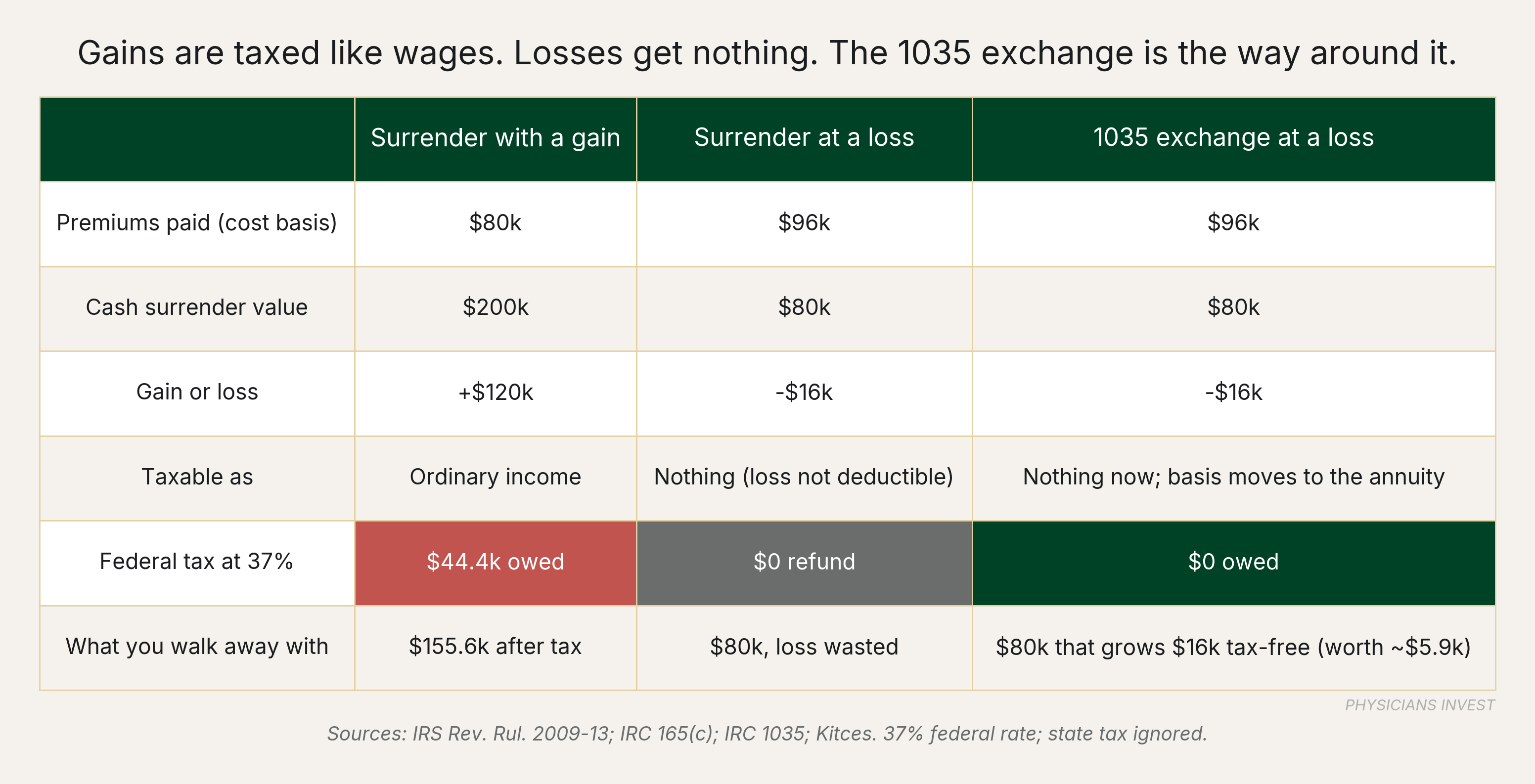 Sources: IRS Rev. Rul. 2009-13; IRC 165(c); IRC 1035; Kitces. 37% federal rate; state tax ignored.
Your three main options: Keep, Restructure, Surrender
- Keep it. If you go this route, you can ask the carrier to pay as much premium as it can out of dividends so no more cash leaves your account.
- Restructure it, through reduced paid-up (RPU) or a 1035 exchange.
- Surrender it for the cash value.
Reduced paid-up, in plain language: you tell the carrier to stop billing you, and your cash value buys a smaller policy that is fully paid, for life. No money changes hands, so there's no tax. It's permanent. And you have to elect it on purpose, because if you simply stop paying, your contract's automatic nonforfeiture option kicks in on its own. State law requires that option to be named in the policy and to take effect if you don't elect something else within 60 days (NAIC Model 808). In most participating whole life contracts that default is extended term coverage, which runs a set number of years and ends with nothing. Check your policy: with a loan outstanding, the default is often reduced paid-up instead.
MEC, in plain language: a modified endowment contract is the IRS label for a policy funded too fast, with more premium in the first seven years than a paid-up-in-seven schedule allows. Once tagged, it stays tagged, and every loan or withdrawal is taxed gain-first plus a 10% penalty before age 59½ (IRC 7702A). The trap that triggers this is timing. If you cut the death benefit inside the first seven contract years, which is what reduced paid-up (RPU) does, and the IRS retests the policy as if it had been issued at the smaller face amount from day one, which can retroactively turn a clean policy into a MEC (IRC 7702A(c)(2)). After year seven, a reduced paid-up election does not trigger that retest. Either way, ask the carrier to run the test in writing before you elect.
Lastly, if you have a loan against the policy, we think letting the policy lapse is the worst option on the menu. The Tax Court treats the loan balance as income you received, so you get a tax bill and no check (Mallory, 2016). One way to avoid that outcome is to repay it from outside funds first.
The Case For Keeping It
Sunk cost is sunk. The commissions to the insurance salesman came out of years one through three and they're gone either way. What's left is the forward return, which could be reasonably expected to come in around 3% to 5% a year, depending on whether you trust the guaranteed or the projected column of your illustration. It is tax-deferred which is nice, has a guaranteed floor, and has no volatility (its value doesn't swing with the market). White Coat Investor, no friend of the product, says keep anything 15 to 20 years in. If you keep your policy, consider it as part of your “fixed income/bond” allocation and accept that returns will probably underperform equity investments.
For those nearing retirement, another benefit of keeping it is that cash value doesn't fall in a bear market, so a physician near retirement can spend from it the year after a drop instead of selling stocks at the bottom to fund lifestyle (Pfau; industry-funded research, real mechanism).
Lastly, a few physicians have a genuine need for permanent coverage: a dependent who will never be self-sufficient or is special needs, a buy-sell agreement in a practice, or an estate tax in a state with a low threshold. The federal estate tax is no longer a reason for almost any physician: the exemption is $15 million per person, permanently, since January 1, 2026.
The Case Against Keeping It
The case against isn't that the policy is worthless or will lose money. Many worse decisions could be made than whole life insurance. The reason to surrender is that other available investment opportunities are more attractive and there is a large opportunity cost (the return you give up by not being somewhere better) to staying in the policy.
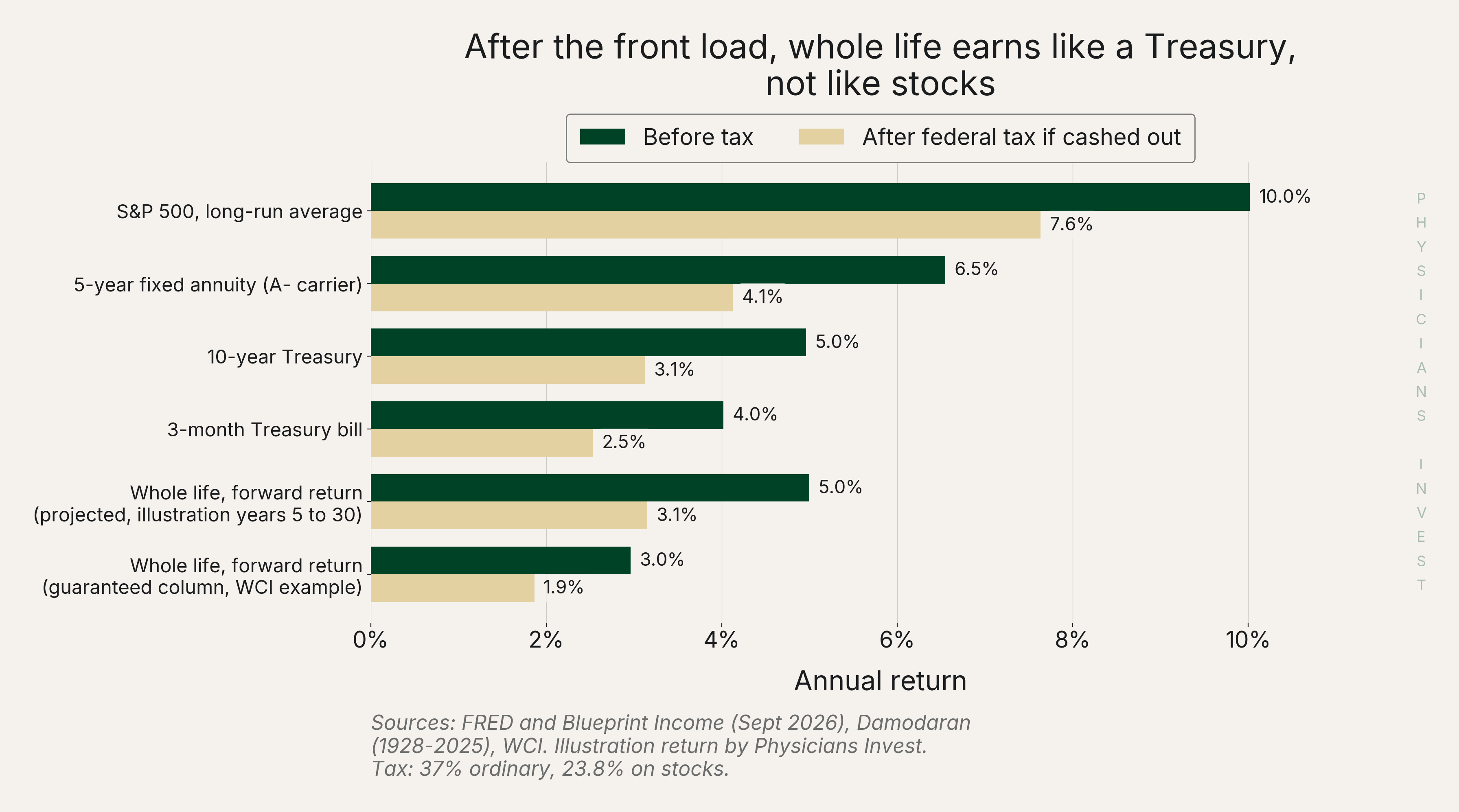 Sources: FRED and Blueprint Income (Sept 2026), Damodaran (1928-2025), WCI. Illustration return by Physicians Invest. Tax: 37% ordinary, 23.8% on stocks.
Today, the projected forward return for whole life insurance sits between a 3-month Treasury bill at 4.02% and a 10-year Treasury at 4.96% before tax, and that forward return is an illustration, not a guarantee.
The product is also priced on you quitting payments. Gottlieb and Smetters, in the American Economic Review, found that 29% of permanent policies lapse within three years and 57% within ten, and that insurers profit on the people who leave and lose money on the people who stay. White Coat Investor's version: part of your dividend is the fees of the people who surrendered.
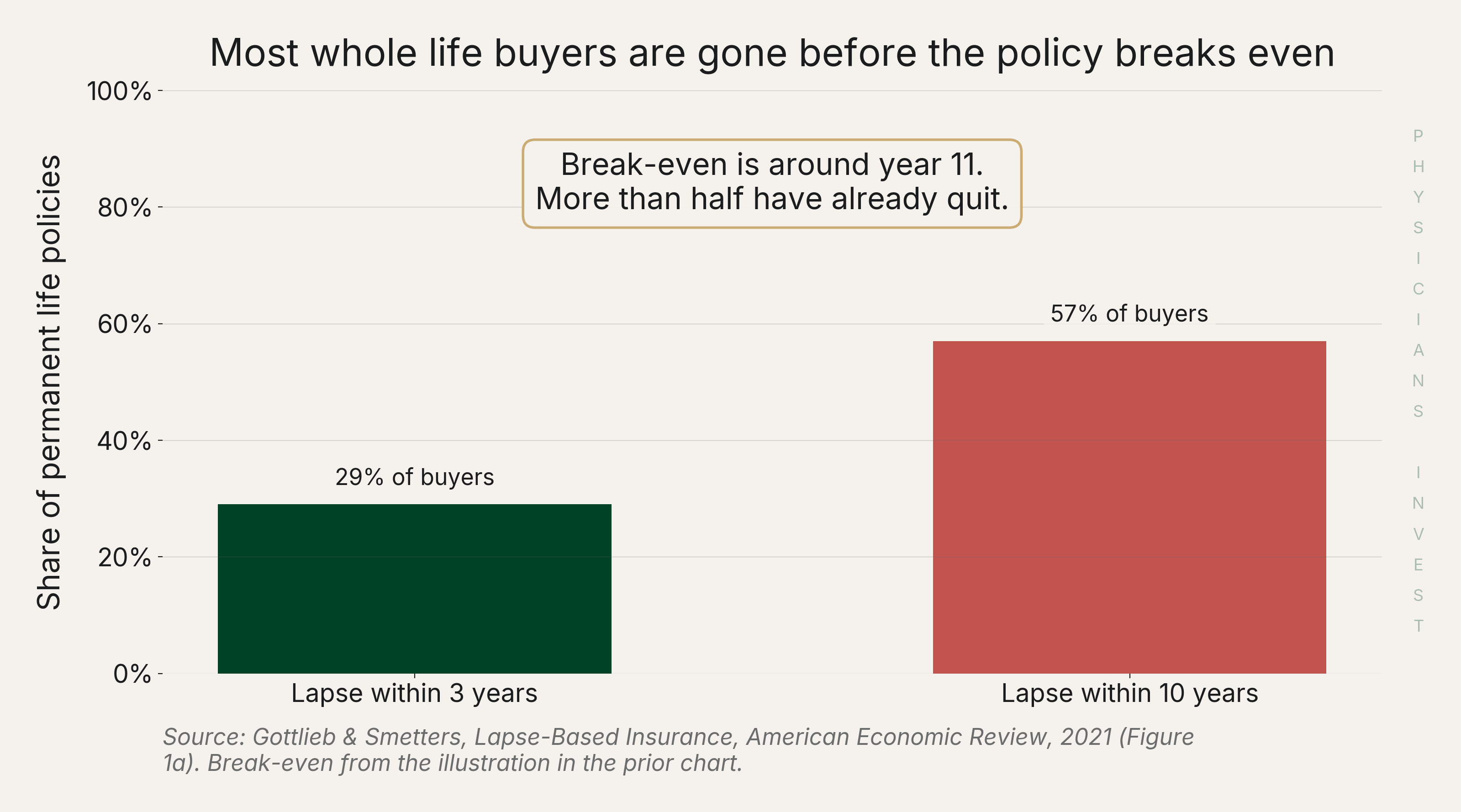 Source: Gottlieb & Smetters, Lapse-Based Insurance, American Economic Review, 2021.
The third leg of the pitch is asset protection, and it is aimed squarely at physicians worried about a malpractice judgment. Whether it holds up depends on your state. Texas and Florida shield the cash value with no dollar cap. Massachusetts, New Hampshire, South Dakota, and Washington shield essentially none of it for the policy owner. California protects $17,525 of loan value and no more. If creditor protection is your reason for keeping the policy, look up your state before you count on it because for many physicians that won’t matter anymore.
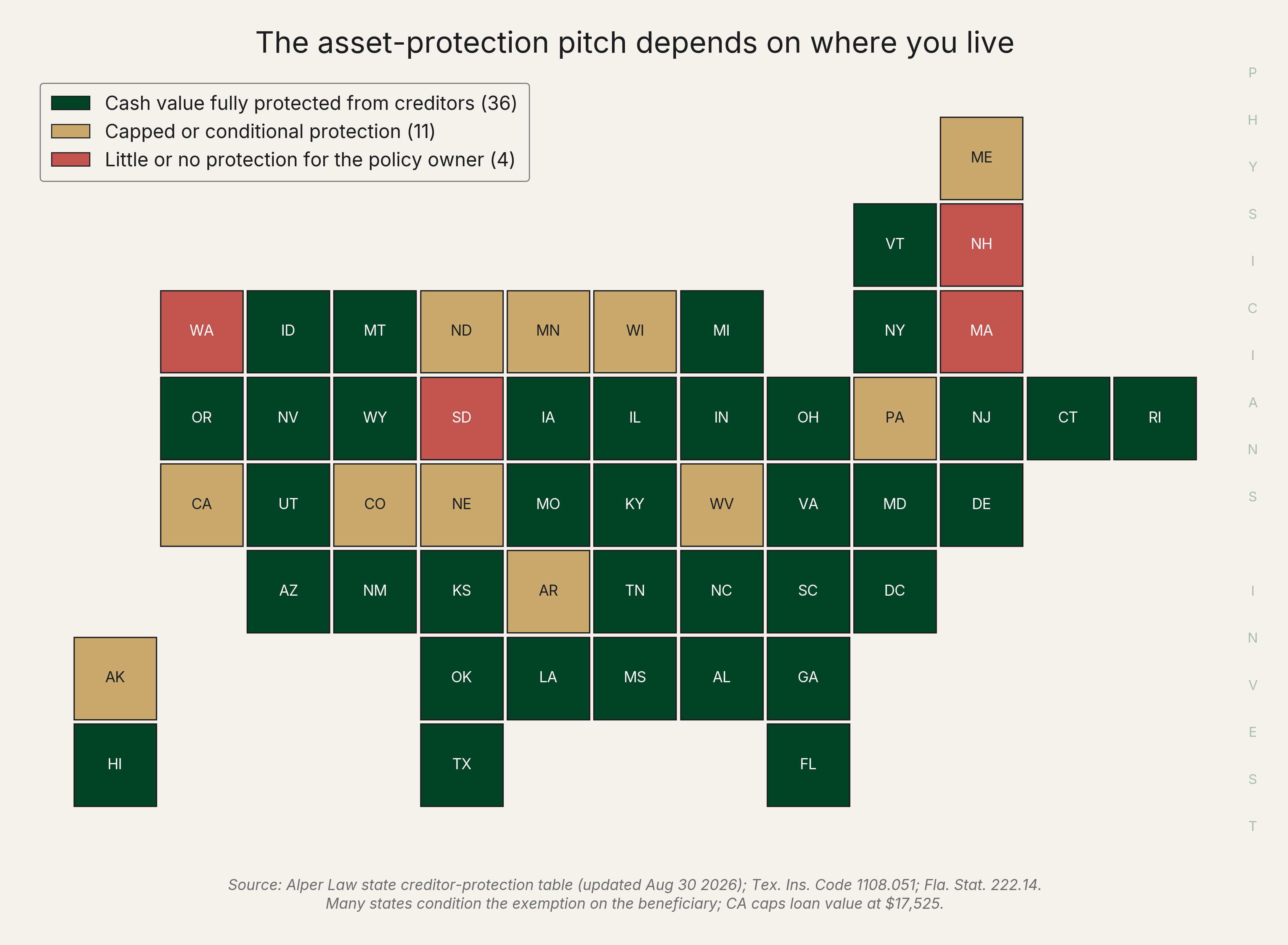 Source: Alper Law state creditor-protection table (updated Aug 30 2026); Tex. Ins. Code 1108.051; Fla. Stat. 222.14.
One more thing about how these policies end up in physicians' hands. In November 2025, The Guardian interviewed 21 current and former Northwestern Mutual workers. They described planning software that will invariably recommend whole life, instructions to recommend it even to young people with no dependents, and interns who worked through their own friend lists. Whoever sold you the policy was probably following a script. That doesn't change the math, but it should take some of the sting away knowing that your “friend” wasn’t intentionally scamming you.
Keep, Restructure, or Surrender
 Author synthesis. Tax treatment: IRS Rev. Rul. 2009-13; IRC 165(c), 1035 and 7702A. Nonforfeiture options: NAIC Model 808.
How to Decide
Two numbers are needed for your decision: how many years in are you, and is the cash value above or below what you paid. Both come from one call or email to the carrier. Ask for an in-force illustration (a fresh projection of your actual policy, showing the guaranteed and projected columns) and a cost-basis letter.
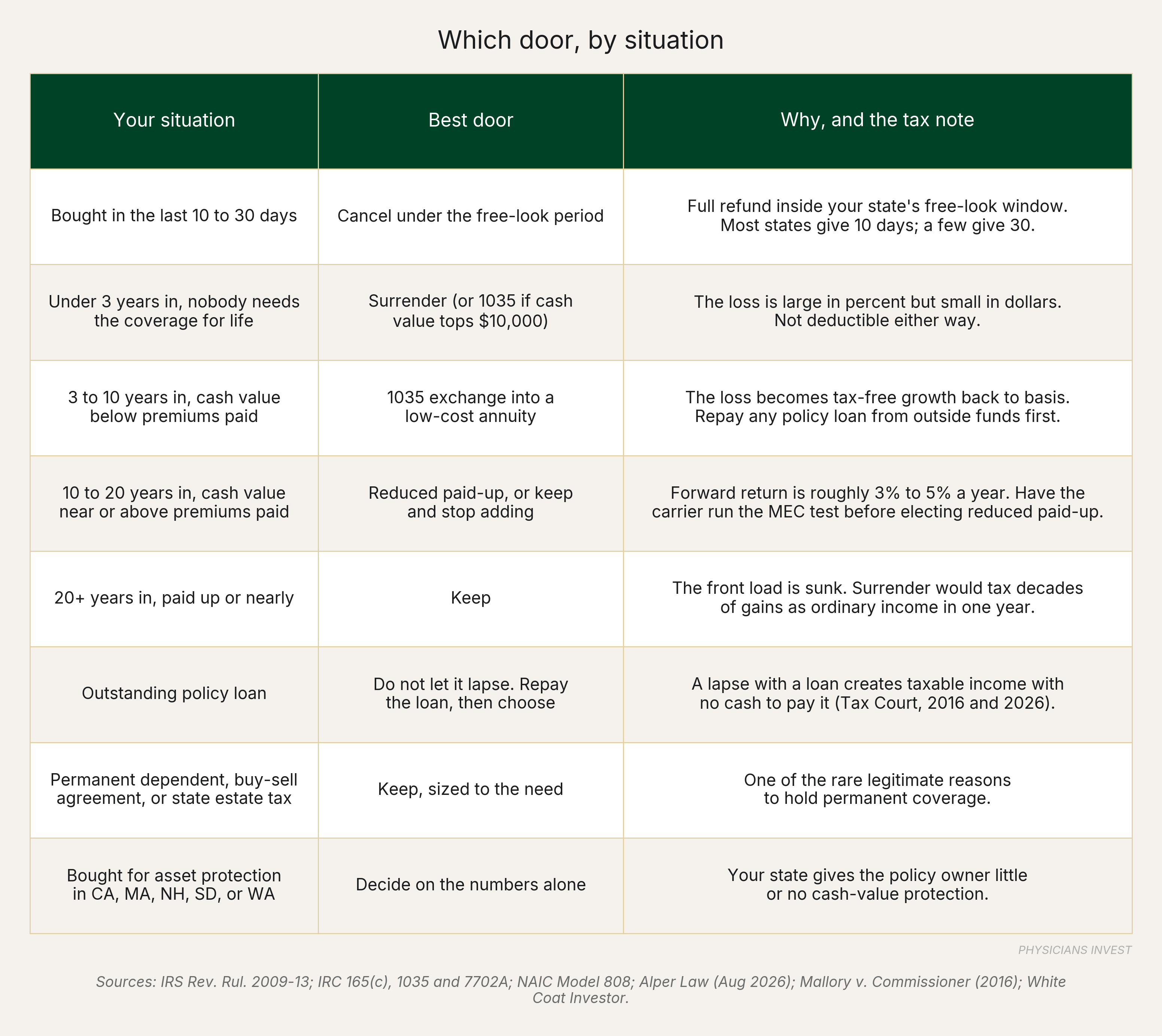 Sources: IRS Rev. Rul. 2009-13; IRC 165(c), 1035 and 7702A; NAIC Model 808; Alper Law (Aug 2026); Mallory v. Commissioner (2016); White Coat Investor.
Here are two checklists to walk through depending on where your cash value sits. The mechanics are general. Confirm your policy's specifics, and the tax treatment, with your carrier and a tax professional before you execute either path as many policies differ in their details.
If your cash value is above what you paid:
| Step | What to do | Why it matters |
|---|---|---|
| 1 | Request the in-force illustration and a cost-basis letter. | The 1099-R will use the carrier's basis number. Dividends you took in cash lower it. |
| 2 | Compute the gain: cash surrender value minus basis. | Every dollar is ordinary income in the year you surrender. |
| 3 | Repay any policy loan from outside funds first. | A loan paid off out of cash value at surrender is still taxable gain to you. |
| 4 | If the gain is large, consider a 1035 exchange into a low-cost annuity instead of surrendering. | Defers the tax, or spreads it across annuity payments, instead of stacking it on a peak-income year. |
| 5 | If you still surrender, do it in a low-income year if one is coming (sabbatical, part-time, retirement). | Ordinary income at 24% beats 37%. |
| 6 | Sign the surrender form and set aside the tax. | The check arrives in weeks. The bill arrives in April. |
If your cash value is below what you paid:
| Step | What to do | Why it matters |
|---|---|---|
| 1 | Get the in-force illustration and the carrier's cost-basis figure. | The loss is basis minus cash value. You need the exact basis. |
| 2 | Confirm the cash value clears the annuity minimum ($10,000 at Fidelity). | Below the minimum, a plain surrender is the only door. |
| 3 | Repay any policy loan from outside money, months before the exchange. | A loan extinguished as part of a 1035 is taxable "boot". |
| 4 | Formally suspend premiums. Do not just stop paying. | Stopping quietly triggers your contract's automatic default, often extended term, which ends with nothing. |
| 5 | Open the annuity and file the carrier's 1035 exchange form. Money moves carrier to carrier. | Taking a check breaks the exchange and becomes a taxable surrender. |
| 6 | Let it grow back to your original basis. | Growth up to basis is tax-free. The wasted loss becomes recovered dollars. |
| 7 | At basis, surrender the annuity. Don't let it run past basis. | Gains above basis are ordinary income, plus 10% if you're under 59½. |
One practical note. The usual advice for a 1035 exchange is to move the money into a variable annuity and let stocks grow it back to basis. In 2026 there is a calmer route. As of September 2026, one A- rated carrier is paying about 6.5% on a five-year fixed annuity, which gets you back to basis with no market risk. Check that the product accepts a 1035 exchange before you file.
Sources
Policy
- IRS Publication 525 (2025), Surrender of policy for cash
- IRS Rev. Rul. 2009-13
- IRS Rev. Rul. 2020-05
- IRS Rev. Rul. 2007-24 (taking a check breaks a 1035 exchange)
- 26 U.S.C. 165(c) (limits on individual loss deductions)
- 26 U.S.C. 1035 (tax-free exchanges; basis carryover via 1035(d)(2))
- 26 U.S.C. 7702A (modified endowment contracts)
- NAIC Standard Nonforfeiture Law, Model 808
- Mallory v. Commissioner, T.C. Memo 2016-110 (Missouri Bar summary)
- Morgan Lewis, $15 million federal estate exemption
- Alper Law, life insurance creditor protection by state
- Tex. Ins. Code 1108.051
- Fla. Stat. 222.14
Data
- FRED: 10-year Treasury (DGS10), FRED: 3-month bill (DTB3)
- Federal Reserve FOMC statement, September 16, 2026
- Blueprint Income fixed annuity rates (September 22, 2026)
- Damodaran, historical returns 1928-2025
- MassMutual 2026 dividend, New York Life 2026 dividend, Guardian 2026 dividend, Penn Mutual 2026 dividend, Northwestern Mutual 2026 dividend interest rate
- Whole life cash value illustration (Insurance & Estates)
- Gottlieb & Smetters, Lapse-Based Insurance, American Economic Review 2021
Analysis
- White Coat Investor: 10 reasons people regret whole life
- White Coat Investor: whole life in the distribution phase
- White Coat Investor: how to dump your whole life policy
- White Coat Investor: the 1035 exchange
- Kitces: using a 1035 exchange to turn unneeded life insurance into an annuity
- White Coat Investor: debunking the myths of whole life
- Pfau, cash value as a volatility buffer (Forbes)
- The Guardian on Northwestern Mutual (Inkl mirror)
Related from Physicians Invest