The 2-Minute Version
- The average physician side gig earns about $34,000 a year, roughly 10% of a doctor's income. Don't go into it expecting it to ever replace your salary. Rarely does part-time effort produce salary replacement.
- The real payoff is four things: you sharpen a new skill, earn a little cash, open a powerful tax advantage, and widen your luck surface.
- Pick the gig that fits your skills and specialty. Don't quit your job, don't expect to get rich off of it, and don't worry about what to start. Just start something and pivot if needed.
The Dollar Math The Roth Solo 401(k) is made available to most single employee businesses which most side gigs qualify for. Routing $20,000 a year of side income into a Roth Solo 401(k) compounding at 7%, grows to roughly $820,000 in 20 years. That near million dollar balance is tax-free to withdraw in retirement.
Overview of Physician Side Gig Landscape
According to the Medscape Physician Side Gigs Report, the average physician side gig brings in about $34,000 a year (2023 data). It's important to understand that a side gig is rarely going to come close to replacing your paycheck. In fact, it earns about 10% of what most physicians make. The reason to start one anyway is still strong and is supported by four reasons.
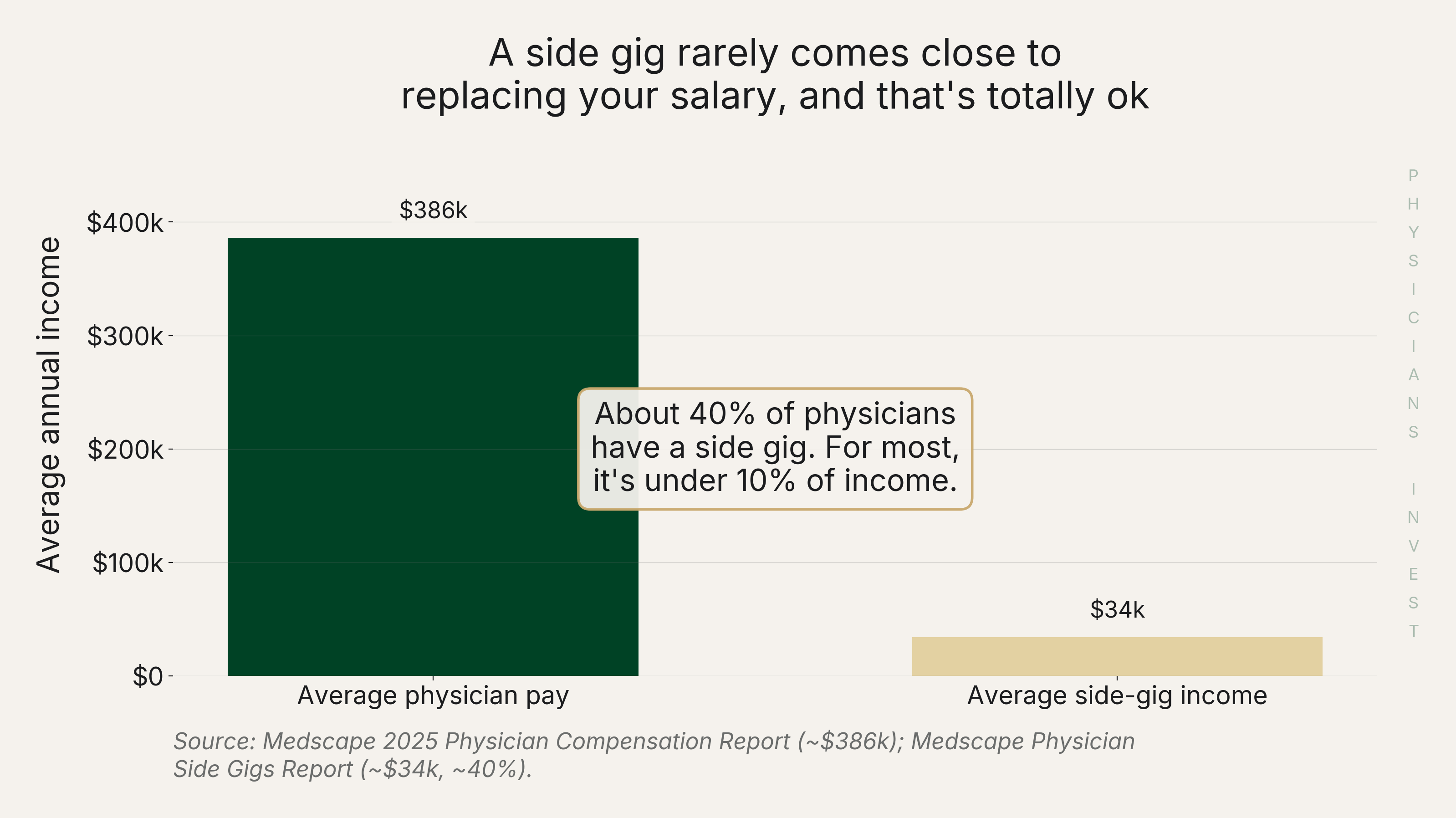 Source: Medscape 2025 Physician Compensation Report; Medscape Physician Side Gigs Report.
An entrepreneurial side gig has 4 notable advantages:
1. You get better. You learn something new and build a skill set outside of medicine. Entrepreneurial skills make you a sharper operator, and they compound for the rest of your career.
2. You earn some cash. It's always nice to have extra cash but the amount will often pale compared to your main salary. Think of this as a bonus on top of the other three advantages in this list.
3. You open a tax door. Your first dollar of 1099 income (self-employment income) unlocks a solo 401(k) and a long list of business deductions. For a W-2 physician, this tax door is often the biggest prize of the four.
4. You widen your luck surface. You cannot force the breakout outcome but what you can do is put yourself in a position to get lucky. A YouTube channel, an Instagram, or a product takes off for a handful of physicians every year (albeit after they spent years of work building the foundation).
What are the tax implications?
Taxes are the most tangible benefit, so let's start there.
The bad news first. Self-employment income does come with extra tax, and the self-employment tax headline rate of 15.3% scares a lot of physicians off. There is good news though. For a W-2 attending, the real marginal cost on side income is about 3.8%. Your salary already filled the Social Security wage base for the year, so your side income owes only the Medicare piece, about 3.8%. (That 3.8% applies once your household income clears about $200,000, which most attendings do. Below that, it is closer to 2.9%.) If all these numbers are confusing, the chart below should help explain it. As a note, the 3.8% is on top of all the federal and state income taxes that are also due and are based on your tax bracket.
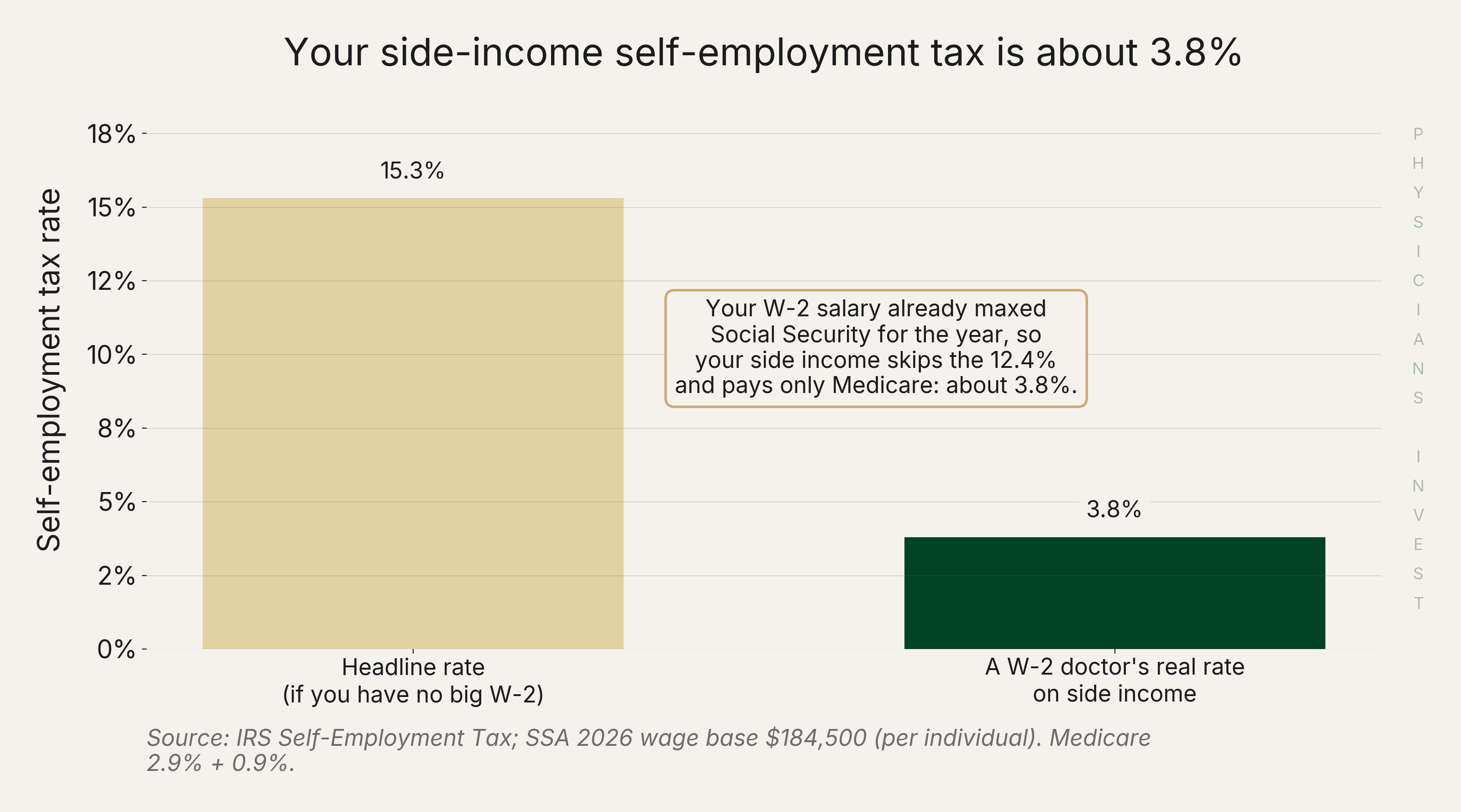 Source: IRS Self-Employment Tax; SSA 2026 wage base $184,500 (per individual).
The good news next. A side gig opens up significant tax advantages that far outweigh the self-employment tax due. The two main areas of advantages are deductions and specialized retirement accounts.
On deductions, a side business lets you write off vehicle costs, a home office, travel, and a dozen other categories a W-2 employee cannot touch. A physician-focused CPA earns their fee here and we recommend finding a strong CPA if you decide to go the side gig route.
For retirement accounts, a side gig lets you open a solo 401(k) on top of the 401(k)/403(b) that your employer already offers. Being consistent about putting just $20k into a Solo 401(k) opened in the name of your side business can grow to over $800,000 (tax-free) over a 20 year period. The chart below illustrates this. If you need help setting one of these up, we can help.
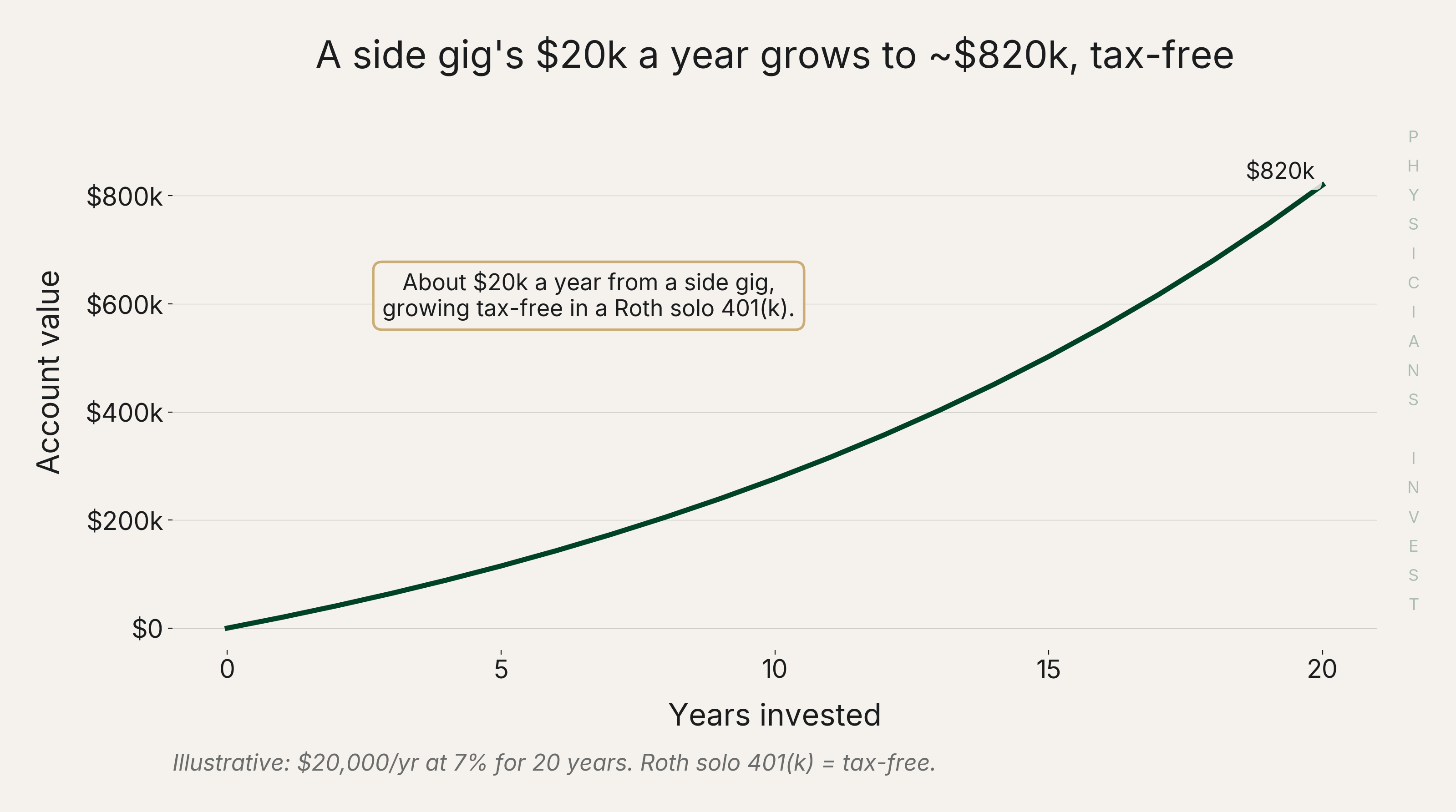 Source: Illustrative. $20,000/yr at 7% for 20 years. Roth solo 401(k) = tax-free.
What are common options for side gigs? A list of 7.
Many physicians want to do something on the side but don't know where to start. The most important thing is to JUST START. You can always quit and pivot, it is just a side gig. Here are the seven most common ways physicians earn 1099 income.
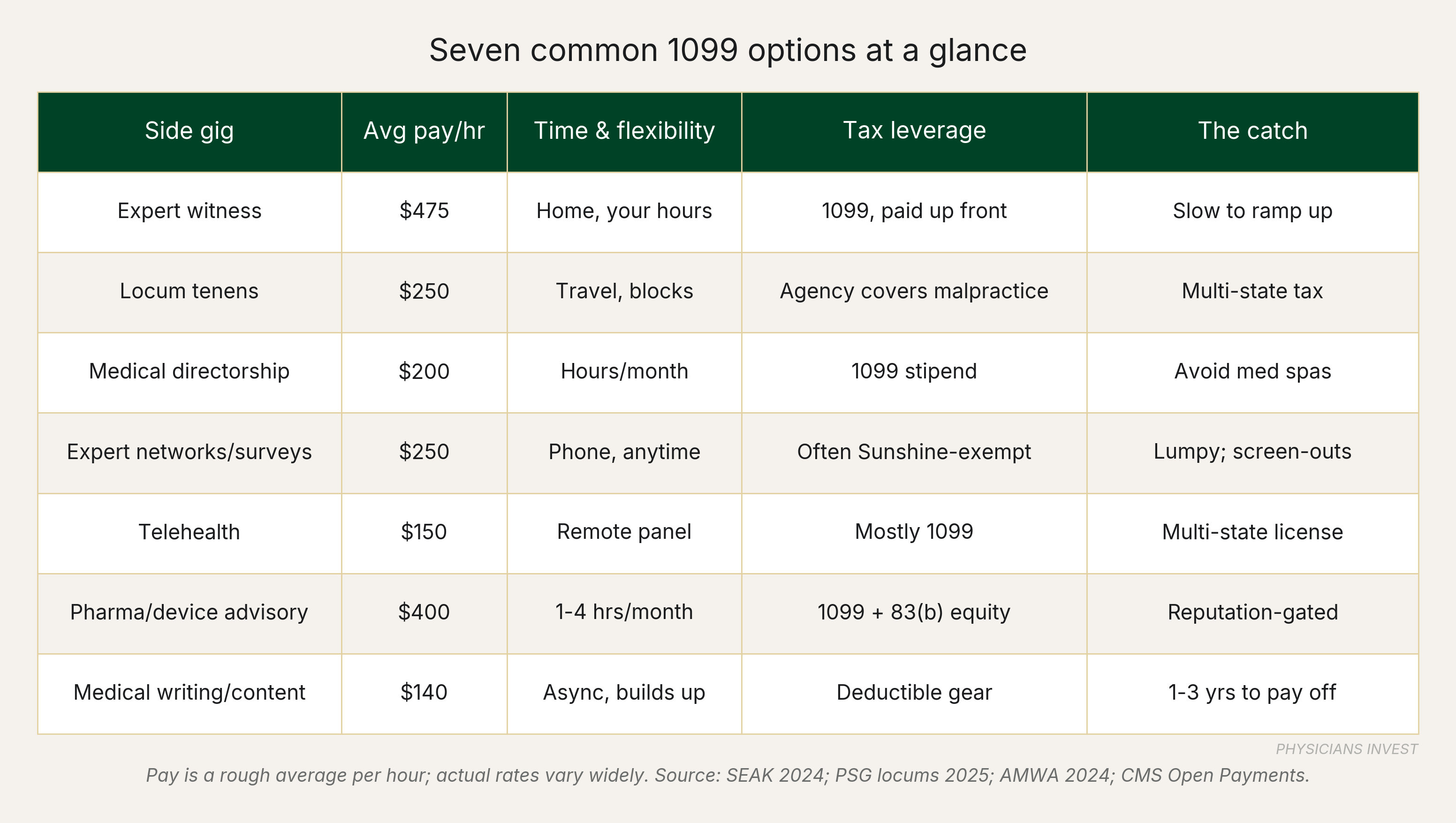 Source: SEAK 2024 Fee Survey; Physician Side Gigs locums database 2025; AMWA 2024; CMS Open Payments; ZipRecruiter 2026.
-
Expert witness and medical-legal review This opportunity pays the most per hour, around $475.
Advantages:
- You get paid up front
- Executed from home on your schedule
- Non-refundable retainers
- Uses the credentials you already have
Disadvantages:
- Slow referral ramp
- Stress of testimony
-
Locum tenens and moonlighting Pays $140 to $370 an hour depending on specialty.
Advantages:
- Agency covers travel
- Agency covers malpractice
- Clinical setting feels familiar
Disadvantages:
- Requires travel normally
- No benefits
- Multi-state taxes
-
Medical directorship Pays $150 to $250 per hour and scales well.
Advantages:
- Easy to scale
- Low time commitment
Disadvantages:
- Significant liability
- Requires competent midlevels to execute correctly
-
Expert networks and survey panels A zero-barrier option you can do from your computer and phone.
Advantages:
- Very high per hour pay for consulting (often $300 to $600)
- Straightforward billing
- Low headache
Disadvantages:
- Infrequent and one-off
- Finicky consultant companies
-
Telehealth $100 to $240 an hour effective.
Advantages:
- Decent effective hourly rate (but often 15 minute chunks)
- Typically decent volume in fields like dermatology
- Can do from anywhere
Disadvantages:
- Only a few low-time cases per day
- Multi-state taxes/registrations might be required
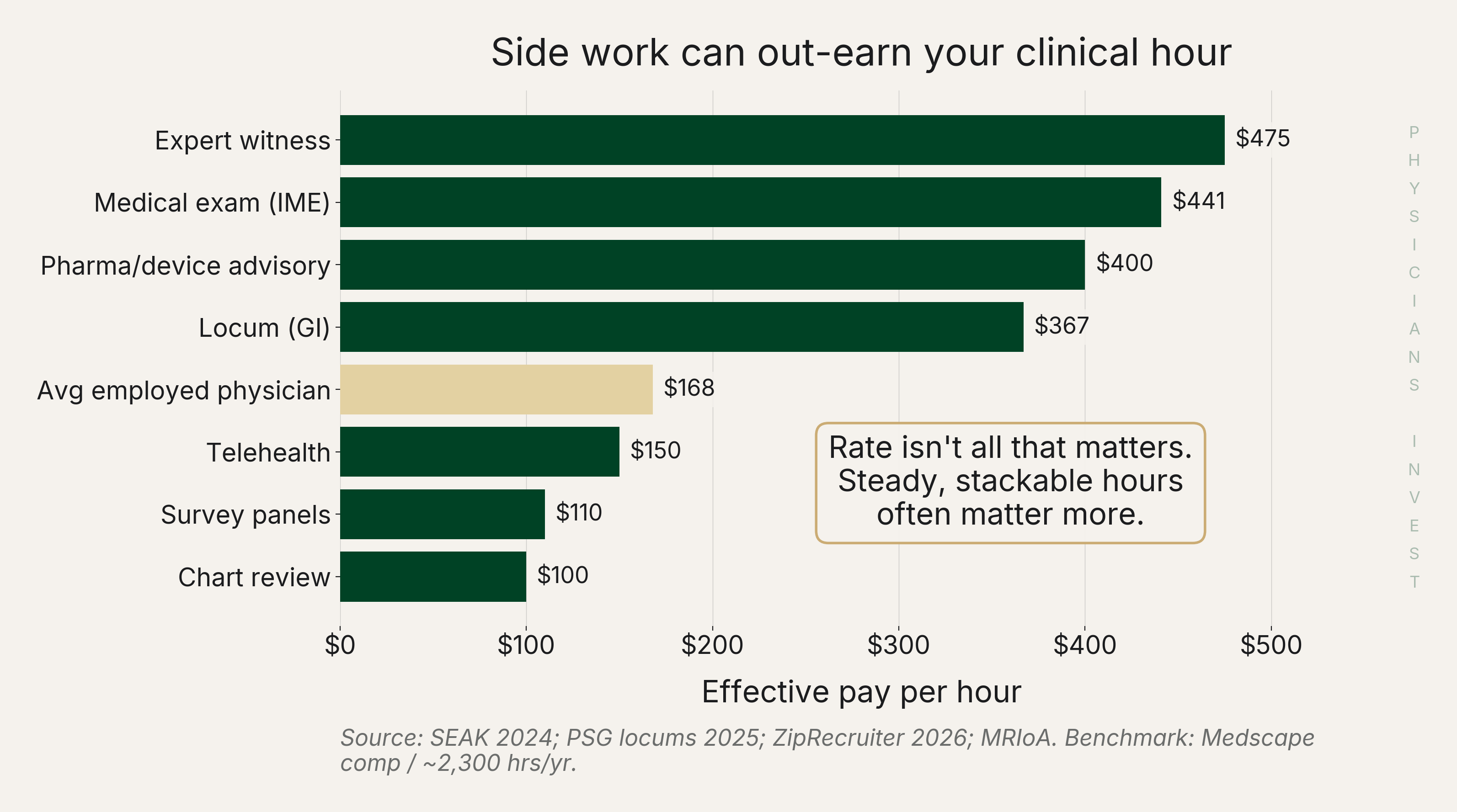 Source: SEAK 2024; Physician Side Gigs locums data 2025; ZipRecruiter 2026; MRIoA.
-
Pharma, device, and startup advisory This option has the highest ceiling because the pay is often not by hour but through equity.
Advantages:
- Equity can lead to outsized payoffs (but delayed)
- Typically fun and interesting
Disadvantages:
- Payout not guaranteed and could be illiquid for a long time
- Often comes with longer term time commitments
- Opportunities can be hard to find without a strong network of connections
-
Medical writing, content, and courses This is the social media model. It scales further than anything else on this list, and it is the least guaranteed. This is the path that maximizes your luck surface.
Advantages:
- Income can scale far beyond an hourly rate
- Builds a brand that acts as a long term asset
- Physician credentials help bring legitimacy
Disadvantages:
- Slowest to payoff. Often, years of effort are required before payout is seen
- Internet critics are ruthless
- Can inhibit privacy
The Move
The move here is to make a move. Don't overthink. Just get something going outside your main job and you can pivot later if needed.
- Pick the gig that fits your edge. Start with what is uniquely yours such as your skills, your connections, your specialty. Don't just chase the highest headline rate because they often come with inconsistency. Further find something you enjoy because the option you can stick with long-term is the one that has the highest likelihood of success. The chart below maps common gigs to specialties to help you game-plan.
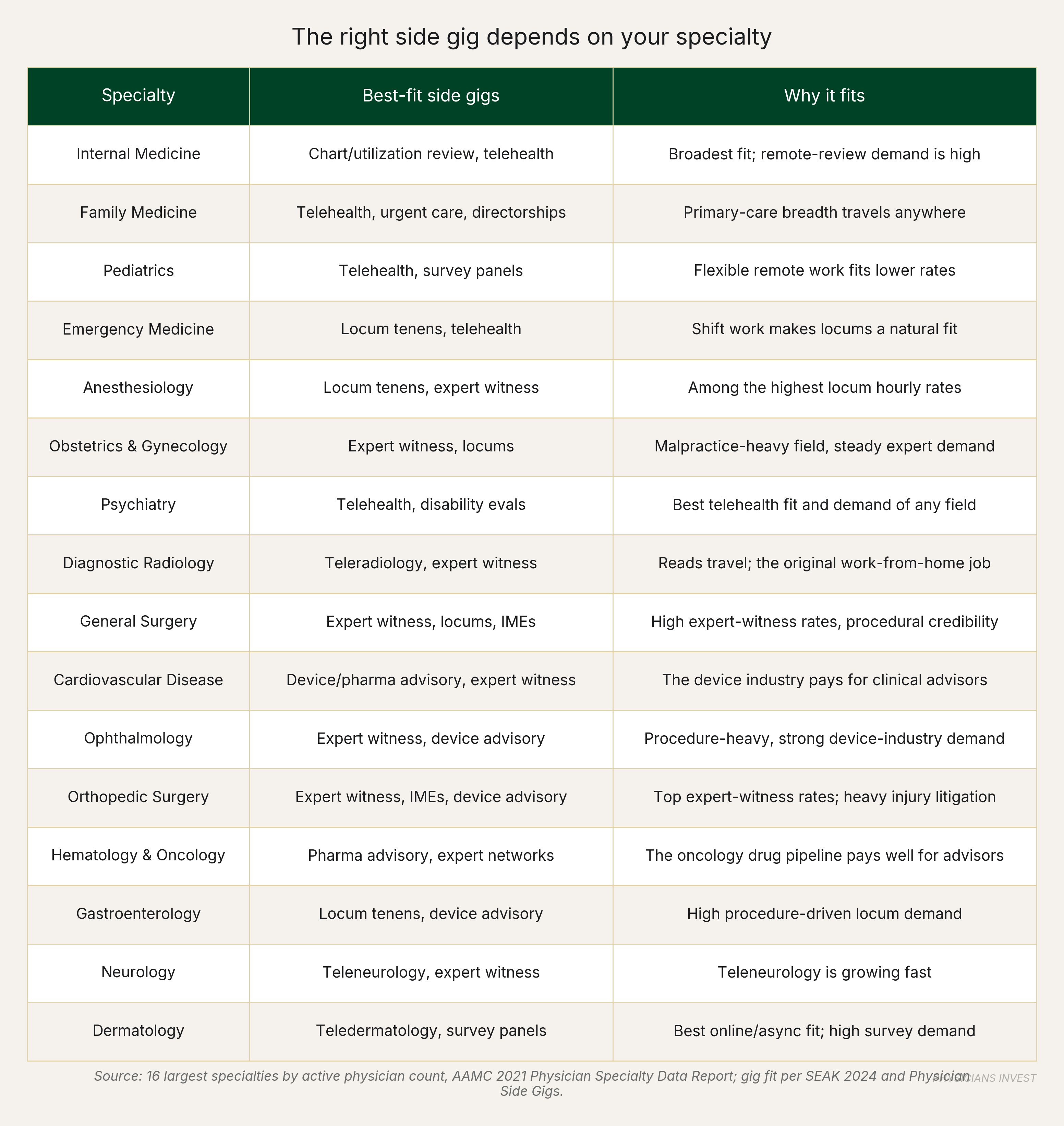 Source: 16 largest specialties by active physician count, AAMC 2021 Physician Specialty Data Report.
- Still stuck for ideas? Ask people in your field privately what has worked. Beware of people pushing strategies or options on social media. Often "selling you" is their income source and not what they say they are doing. When someone really finds something that works, they rarely openly share it publicly because in most options it brings in competition.
- Pick something that fits your schedule and your priorities. Keep your day job, keep your expectations modest, and treat the side gig as the open door to a bigger upside, not a salary replacement.
- Go in with clear eyes. The promise that passive income will set you free is a bit of a lie. More often you become less free, because a second income stream needs constant managing and quietly turns into a second job. Do it for the skills, the tax door, and the open shot at luck.
Sources
Data
- Medscape Physician Side Gigs Report (via Advisory Board, Oct 2023) — side-gig prevalence ~40%, average ~$34k/yr; most-common gig types
- Medscape 2025 Physician Compensation Report — physician compensation overview; 2025-cycle side-gig prevalence
- SEAK 2024 Expert Witness Fee Survey — expert witness hourly rates by specialty; median ~$475/hr (deposition)
- Physician Side Gigs locums rate database, 2025 — locum hourly rates by specialty ($140–$370/hr range)
- AMWA 2024 Compensation Report — medical writing income (freelance mean ~$214k gross)
- CMS Open Payments, PY2024 — pharma/device advisory and consulting payment data by physician
- ZipRecruiter: Dermatology Telemedicine (Apr 2026) — teledermatology hourly range ($101–$240/hr)
- AAMC 2021 Physician Specialty Data Report — active physicians by specialty (16 largest specialties)
Analysis
- White Coat Investor: "Why Going 1099 Won't Solve All Your Financial Problems" — honest caveat on small 1099 income; pro-rata/backdoor Roth nuance
- White Coat Investor: "Multiple Streams of Income" — optionality and income-diversification thesis
- Physician on FIRE: "Solo 401(k) vs SEP-IRA for Physicians (2026)" — solo 401(k) vs SEP contribution mechanics; pro-rata interaction
- Physician Side Gigs: Solo 401(k) for Physicians — solo 401(k) pro-rata rule exemption; second-employer profit-sharing bucket
Policy / Tax
- IRS: Self-Employment Tax (Social Security and Medicare Taxes) — 15.3% headline SE tax rate; Medicare-only component for W-2 attendings above the SS wage base
- IRS: One-Participant 401(k) Plans — solo 401(k) structure; separate 415(c) per employer; profit-sharing mechanics
- IRS Notice 2025-67 — 2026 retirement plan limits ($24,500 employee deferral; $72,000 total additions)
- SSA 2026 Contribution and Benefit Base — Social Security wage base $184,500
Related from Physicians Invest